
- Six authors shortlisted for increased £75k prize fund as prize celebrates its 50th anniversary
- Shortlisted books explore the impact faith has had on our collective history, and examine divided societies through time
- Books on Ottoman Empire, witchcraft, parish churches and the rise and fall of statues demonstrate breadth of historical writing.
The Wolfson History Prize, the UK’s most prestigious history writing prize, has today revealed its shortlist for 2022. The prize, which celebrates its 50th anniversary this year, showcases the best accessible historical non-fiction titles from the previous year.
The six shortlisted titles cover a range of socio-political themes, with the influence of religion appearing across a number of the books in contention for the UK’s most valuable history prize.
Topics featured in the shortlist include: witch-hunting and a society in disarray in 17th-century Massachusetts, the century leading up to the Glorious Revolution from the perspective of Britain’s European neighbours, the development of ideas about God through history, the role of the church in Medieval communities, the story of the Ottoman dynasty over 700 years, and what fallen statues tell us about historical memory.
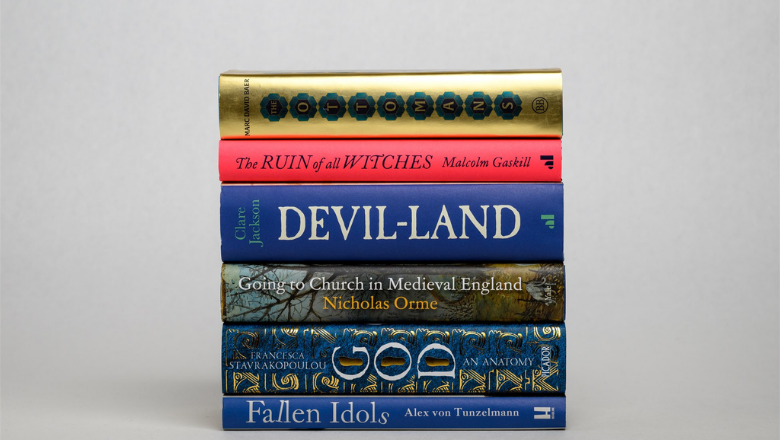
The books shortlisted for the Wolfson History Prize 2022 are:
- The Ottomans: Khans, Caesars and Caliphs by Marc David Baer (Basic Books)
- The Ruin of All Witches: Life and Death in the New World by Malcolm Gaskill (Allen Lane)
- Devil-Land: England Under Siege, 1588-1688 by Clare Jackson (Allen Lane)
- Going to Church in Medieval England by Nicholas Orme (Yale University Press)
- God: An Anatomy by Francesca Stavrakopoulou (Picador)
- Fallen Idols: Twelve Statues That Made History by Alex von Tunzelmann (Headline)
Chair of the judges, David Cannadine, commented: “This year’s Wolfson History Prize shortlist once again showcases the diversity and vigour of history writing in the UK. The judges were impressed by the variety, originality, and quality of research demonstrated by the six shortlisted books. As well as being engaging reads, they are all highly deserving of a place in the eminent roll call of authors celebrated by the prize over the past fifty years.”
Paul Ramsbottom, Chief Executive of the Wolfson Foundation, which awards the prize, said of the shortlist: “We are delighted to announce the shortlist for the Wolfson History Prize 2022, reflecting the very best historical writing in the UK today. This year marks fifty years of the Wolfson History Prize and its mission – to champion the importance of high-quality, accessible history writing – is as critical now as it has ever been. This past year has revealed much about how history can be valued, contested and re-evaluated. It has also revealed why it is vital for us to engage carefully and thoughtfully with the experiences of those who came before us: a reminder of the importance of history to our lives.
“Whether or not you agree with their arguments, these six books will inspire and provoke. They offer the opportunity to learn more about what mattered to previous societies and to reflect on the significance of the past to current concerns and debates. The books shortlisted this year demonstrate that turbulent times are nothing new and show how different societies have dealt with such challenges.”
Several of the shortlisted titles explore the importance of religion throughout the centuries, discussing the wider implications of faith on retellings of our collective history. Going to Church in Medieval England by Nicholas Orme is an engaging account of parish churches and their role in Medieval communities, demonstrating the presence of religion at every point in a human life, from birth to coming of age, from marriage to death. Francesca Stavrakopoulou’s God: An Anatomy is an original and in-depth exploration of the concept of God, using an examination of God’s physicality to shed new light on the development of monotheistic religions – and Western culture more broadly. In The Ottomans: Khans, Caesars and Caliphs, Marc David Baer reflects on how the multilingual, multireligious, and multiethnic Ottoman Empire managed to hold swathes of Europe for seven centuries, and how religious tolerance and cultural innovation shaped the landscape of East and West through to the present day.
Other books included in the shortlist demonstrate that modern social and political divisions are nothing new, reflecting on different times of crisis across the centuries. In Devil-Land: England Under Siege, 1588-1688, Clare Jackson studies European perceptions of Britain during the turbulent and radical years of the Stuart dynasty, during which civil war and regicide played out against a backdrop of devastating fires, treasonous plots and deadly disease. The Ruin of All Witches: Life and Death in the New World by Malcolm Gaskill also explores a society in turmoil, following one family in Springfield, Massachusetts as the battle between religion and enlightenment breeds paranoia, anger and terror with the onset of a series of witch-hunts.
Finally, Fallen Idols: Twelve Status That Made History by Alex von Tunzelmann highlights the significance of history to modern life, considering how statues define our history, showing that their removal is nothing new, and questioning what statues tell us about how views of the past change over time.
Judges’ comments on the Wolfson History Prize 2022 Shortlist:
The Ottomans: Khans, Caesars and Caliphs by Marc David Baer
‘A hugely impressive sweeping narrative. Covering seven centuries, this book adds a new perspective to global history by emphasising the role of this longstanding and important dynasty.’
The Ruin of All Witches: Life and Death in the New World by Malcolm Gaskill
‘A riveting micro-history, brilliantly set within the broader social and cultural history of witchcraft. Drawing on previously neglected source material, this book is elegantly written and full of intelligent analysis.’
Devil-Land: England Under Siege, 1588-1688 by Clare Jackson
‘A masterpiece that will change our view of the 17th century. Exciting and well-written, it provides fresh insights by looking at England through European eyes.’
Going to Church in Medieval England by Nicholas Orme
‘An engaging and often moving account of how religious life was woven into people’s everyday experiences from Anglo-Saxon times to the Reformation. A sparkling book.’
God: An Anatomy by Francesca Stavrakopoulou
‘Original and courageous. This ambitious yet readable discussion of the physicality of God enhances our understanding of the history of monotheistic religions and Western culture.’
Fallen Idols: Twelve Statues That Made History by Alex von Tunzelmann
‘Intelligent, illuminating and thoroughly enjoyable. A well-researched book that uses carefully chosen case studies to shed light on a topic of contemporary debate.’
The winner of the Wolfson History Prize 2022 will be announced on Wednesday 22 June 2022. To mark the 50th anniversary of the prize, the total fund has been increased to £75,000, with the winner being awarded £50,000 and each of the shortlisted authors receiving £5,000.
The Wolfson History Prize 2022 shortlisted authors will discuss their books and historical writing in a special edition of BBC Radio 3’s Free Thinking in June, with details to follow at a later date. Prize alumni will also join historians in conversation at a Wolfson History Prize anniversary event at Hay Festival on Wednesday 1 June at 7pm, further information can be found here.
The Wolfson History Prize is run and awarded by the Wolfson Foundation, an independent charity that awards grants in the fields of science, health, heritage, humanities & the arts. The Wolfson History Prize 2021 was won by Sudhir Hazareesingh, for Black Spartacus: The Epic Life of Toussaint Louverture, an in-depth exploration of the leader and hero of the Haitian Revolution.
Images (including book jackets/author photographs) can be found here.
For media enquiries, and to request interviews, quotes, and proofs for review please contact: Hannah Bright or Ben McCluskey at Midas on hannah.bright@midaspr.co.uk / ben.mccluskey@midaspr.co.uk or 07943 782 574.
Notes to Editors
About the Shortlisted Authors
Marc David Baer
Marc David Baer is Professor of International History at the London School of Economics and Political Science. He is the author of five books: Honored by the Glory of Islam: Conversion and Conquest in Ottoman Europe, winner, Albert Hourani Prize, Middle East Studies Association of North America; Sultanic Saviors and Tolerant Turks: Writing Ottoman Jewish History, Denying the Armenian Genocide, winner of the Dr. Sona Aronian Book Prize for Excellence in Armenian Studies, National Association for Armenian Studies and Research; The Dönme: Jewish Converts, Muslim Revolutionaries, and Secular Turks; German, Jewish, Muslim, Gay: The Life and Times of Hugo Marcus; and The Ottomans: Khans, Caesars and Caliphs.
Malcolm Gaskill
Malcolm Gaskill is Emeritus Professor of Early Modern History at the University of East Anglia. One of Britain’s leading experts in the history of witchcraft, his works include the highly-acclaimed Witchfinders: A Seventeenth-Century English Tragedy and Between Two Worlds: How the English Became Americans. In November 2021, Allen Lane published his most recent book The Ruin of All Witches – a Sunday Times, The Times and BBC History book of the year.
Clare Jackson
Clare Jackson is the Senior Tutor of Trinity Hall, Cambridge University. She has presented a number of highly successful programmes on the Stuart dynasty for the BBC and is the author of Charles II in the Penguin Monarchs series.
Nicholas Orme
Nicholas Orme is Emeritus Professor of History at Exeter University. He has written more than thirty books on the religious and social history of England, including Medieval Children, Medieval Schools, Medieval Pilgrimage, and The History of England’s Cathedrals.
Francesca Stavrakopoulou
Francesca Stavrakopoulou studied theology at Oxford, where she also earned her doctorate, and is currently Professor of Hebrew Bible and Ancient Religion at the University of Exeter. The author of a number of academic works, she also presented the BBC 2 documentary series Bible’s Buried Secrets. She has regularly contributed to BBC 1’s The Big Questions and Sunday Morning Live, and has also appeared on several BBC Radio 4 and Radio 3 shows. She has written for various newspapers and has spoken about the Bible, religion, and atheism at numerous public events.
Alex von Tunzelmann
Alex von Tunzelmann is a historian and screenwriter. She is the author of five books, including the international bestseller Indian Summer: The Secret History of the End of an Empire. Her feature film debut Churchill, starring Brian Cox, was released in 2017. She lives in London.
About the Wolfson History Prize
First awarded by the Wolfson Foundation in 1972, the Wolfson History Prize remains a beacon of the best historical writing being produced in the UK, reflecting qualities of both readability for a general audience and excellence in writing and research. The most valuable history writing prize in the UK, the Wolfson History Prize is awarded annually, with the winner receiving £50,000, and the shortlisted authors receiving £5,000 each. Over £1.3 million has been awarded to more than 120 historians in the prize’s 50-year history. Previous winners include Mary Beard, Simon Schama, Eric Hobsbawm, Amanda Vickery, Antony Beevor, Christopher Bayly, and Antonia Fraser.
To be eligible for consideration, authors must be resident in the UK in the year of the book’s publication (the preceding year of the award), must not be a previous winner of the prize and must have written a book which is carefully researched, well-written and accessible to the non-specialist reader.
You can connect on Twitter via @WolfsonHistory / #WolfsonHistoryPrize.
About the Wolfson History Prize Judges
David Cannadine (Chair of the judges) is an historian who has written on modern Britain, the United States, the British Empire and the wider world, and is a trustee of the Wolfson Foundation. He is Dodge Professor of History at Princeton University, a Visiting Professor of History at the University of Oxford, the editor of the Oxford Dictionary of National Biography, and served as President of the British Academy from 2017 to 2021. He has previously taught at the University of Cambridge and Columbia University, New York. He was Director and Professor of History at the Institute of Historical Research from 1998 to 2003. He is a Fellow of the Royal Society of Literature, the Society of Antiquaries, and the Royal Historical Society. In 2009 he was awarded a knighthood for services to scholarship. His publications include Victorious Century: The United Kingdom, 1800-1906 (2017), Margaret Thatcher: A Life And Legacy (2017), The Undivided Past: Humanity Beyond our Differences (2012), Mellon: An American Life (2006), Ornamentalism: How the British Saw Their Empire (2001), Class in Britain (1998), and The Decline and Fall of the British Aristocracy (1990). He has served on many cultural organisations concerned with heritage and the arts, including the National Portrait Gallery, English Heritage, Westminster Abbey, the Victorian Society, Royal Academy Trust, and the Birmingham and Midland Institute.
Richard Evans is Regius Professor Emeritus of History at the University of Cambridge. He is the author of numerous books on modern German and European History, including Death in Hamburg: Society and Politics in the Cholera Years 1830-1910, which won the Wolfson History Prize in 1989. His recent books include The Pursuit of Power: Europe 1815-1914, a volume in the Penguin History of Europe; Eric Hobsbawm: A Life in History, published in February 2019 by Little, Brown; and, most recently, The Hitler Conspiracies: The Third Reich and the Paranoid Imagination, published by Penguin in October 2020. From 2010 to 2017 he was President of Wolfson College, Cambridge and from 2014 to 2020 Provost of Gresham College in the City of London. He is a Fellow of the British Academy and was knighted in 2012 for services to scholarship.
Carole Hillenbrand has been Professor Emerita of Islamic History at the University of Edinburgh since 2008 and Professorial Fellow (Islamic History), at the University of St Andrews since 2013. She studied Modern and Medieval Languages at the University of Cambridge, Arabic and Turkish at the University of Oxford, wrote a PhD on Islamic history at the University of Edinburgh and has held Visiting Fellowships in America and Holland. She was elected an Honorary Life Fellow at Somerville College, Oxford in 2010 and a Corresponding Fellow of the Medieval Academy of America in 2012. She was awarded the King Faisal International Prize in Islamic Studies in 2005 and the British Academy/ Nayef Al Rodhan Prize for Transcultural Understanding in 2016. She is a Fellow of the British Academy, the Royal Society of Edinburgh, and the Royal Historical Society. In 2009 she was awarded an OBE for services to Higher Education and in 2018 was awarded a CBE for services to the understanding of Islamic history.
Diarmaid MacCulloch is a Fellow of Saint Cross College and Campion Hall and Professor emeritus of the History of the Church at the University of Oxford. He is a Fellow of the British Academy, the Royal Historical Society and of the Society of Antiquaries of London; he co-edited the Journal of Ecclesiastical History for twenty years. He was ordained deacon in the Church of England in 1987 and in 2012 was knighted for services to scholarship. His chosen research field has been Tudor England (including a biography of Archbishop Thomas Cranmer and a study of the Reformation under Edward VI); he has also written on the wider history of the European Reformation and on world Christianity generally. His History of Christianity: the first three thousand years (winner of the 2010 Hessell-Tiltman Prize and the 2010 Cundill History Prize, Montreal) was followed by the BBC series A History of Christianity (given the Radio Times Readers’ Award, May 2010). Further television work has included How God made the English, 2012, Henry VIII’s Fixer: the rise and fall of Thomas Cromwell, 2013, and Sex and the Church, 2015. His biography of Thomas Cromwell was published in September 2018. He won the Wolfson History Prize in 2004 for Reformation: Europe’s House Divided 1490-1700.
About the Wolfson Foundation
The Wolfson Foundation is an independent charity with a focus on research and education. Its aim is to support civil society by investing in excellent projects in science, health, heritage, humanities and the arts. Since it was established in 1955, over £1 billion (£2 billion in real terms) has been awarded to more than 12,000 projects across the UK, all on the basis of expert peer review. The Wolfson Foundation is committed to supporting history and the humanities more broadly. In the past 10 years, it has awarded more than £21 million to support postgraduate scholarships in the humanities at universities across the UK, over £17 million to historic buildings, and some £30 million to museums and galleries. You can connect via Twitter @wolfsonfdn.


