
Congratulations on being shortlisted for the Wolfson History Prize 2025. How does it feel to be shortlisted and what would winning mean to you?
Thank you! When I heard I had been shortlisted, I had flashbacks to me as a first-year undergraduate, hiding in the loos crying after lectures because I didn’t understand the content. (And to be honest, flashbacks to other similar situations that came later, not least when writing this book.) Many of the historians I look up to have been on this shortlist. So I wanted to go back to undergraduate me, sniffling in the loos, and say: ‘It’s ok to feel you don’t understand. It doesn’t mean you’re bad at history, it means you’re being challenged. And it will make you better at writing history in the long run, because you know what it’s like not to understand. Also, please take this box of tissues, because you’ve managed to pick the one cubicle to cry in that doesn’t have any loo roll.’
What was the inspiration behind Embers of the Hands?
I always wanted this book to be about the ordinary humans behind the epic sweep of the Viking Age, and the little bits and pieces of their lives that fell between the cracks of history. I’ve travelled to some extraordinary locations for my research – e.g. Greenland, Iceland, the Hebrides, the Northern Isles, Arctic Scandinavia, Svalbard – and that has always been a huge inspiration for my work. But the timbre of the book changed during the writing of it, because the world changed, and so did I. I submitted the proposal to my agent the day before I gave birth, on a sunny day in Oxford, with the laptop balanced on my bump. When I signed the contract with Profile, we celebrated in an entirely unsuitable cocktail bar, with the baby sleeping in a buggy. It was all very nice. But then the pandemic hit. And I was pregnant again. And the next baby wasn’t very well. And suddenly it was lockdown number 3, in the depths of winter, and I was walking around the cold wet streets of London, panic-brainstorming with my spouse, scribbling sleep-deprived ideas in a rain-splattered notebook. For me, there’s an intimacy to Embers of the Hands that reflects the time in which it was written. For the same reason, I also think it modulates into minor keys more frequently than in my previous writing.
For someone who is interested in the Vikings, what wider content (books/places/films) would you recommend?
Where to begin? As a child, Noggin the Nog (that gentle king of the Northmen) was a huge influence, as was Asterix and the Normans (although let’s ignore the mega timeslip that sees Gauls from the 1st century BCE meet up with Vikings from the 9th/10th century CE). People seem to expect me to dislike book/TV series such as Vikings and The Last Kingdom, but I’m a big fan (except when I’m deep in Viking research, at which point they feel too much like work and I’m more likely to be watching RuPaul’s Drag Race on repeat). Music recommendations is an easy one: Wardruna. They’re a Norwegian music group fronted by Einar Selvik, drawing on elements of Old Norse culture – runes, poetry, religion – and Viking Age instruments. We made a BBC Radio 3 documentary with Einar about Viking music last year, and I had to work very hard to hide the fact that I was an enormously uncool fangirl masquerading as a serious historian and broadcaster. I don’t think he fell for it. For books, Neil Price’s Children of Ash and Elm: A History of the Vikings is the finest complete history of the Viking Age out there. And, of course, any number of museums and locations in the UK and abroad. I’m ridiculously excited about Oslo’s new Museum of the Viking Age, which is coming soon. I may begin queuing now, so I can be first in line when the doors are opened.
Why do you feel it is important to celebrate history writing?
What I love about the Wolfson History Prize is that it doesn’t just celebrate history writing. It celebrates research excellence and readability. I think that’s an enormously important combination, and in my experience not as common as we might think. And there’s a reason for that – it’s hard! Or at least, I find it hard, and I think I’d worry if I ever found it easy. At times, trying to distil complicated research and conflicting theories into a clear, engaging narrative feels like an artform approaching alchemy. Will you end up with a flake of gold, or a cowpat-shaped nugget of purest green? (Shout out there to Blackadder, another huge historical influence of my youth.) Then there’s the question of the sheer unknowability of great swathes of the past: how to write history in a way that allows readers to sit comfortably with the blank spaces in time, the moments when the evidence runs out? Perhaps most importantly: at its worst, history can be used as a blunt tool to justify all sorts of unjustifiable beliefs and actions. And history writing, at its best, undercuts this by bearing witness to the ambiguities and contradictions of the human experience.
The Wolfson Foundation awards grants to a wide variety of museums, historic buildings and landscapes. Do you have a favourite historical place, or a place that inspired you?
Too, too many. I have measured out my life in visits to historical sites. I married a fellow historian and our first date was to the island of Lindisfarne where the famous Viking raid of 793 took place – the levels of utter nerddom on our roadtrips cannot be overstated.
Read an extract from Embers of the Hands: Hidden Histories of the Viking Age.
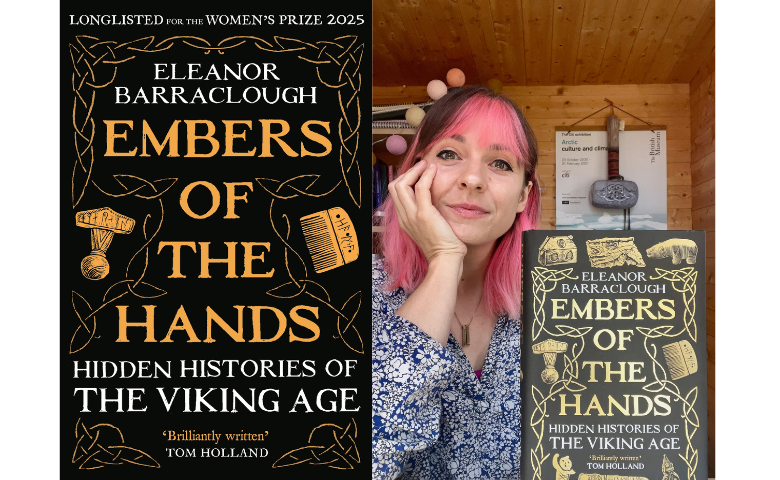
Top images: ‘Embers of the Hands’ book cover; portrait of Eleanor Barraclough (c) Eleanor Barraclough


