
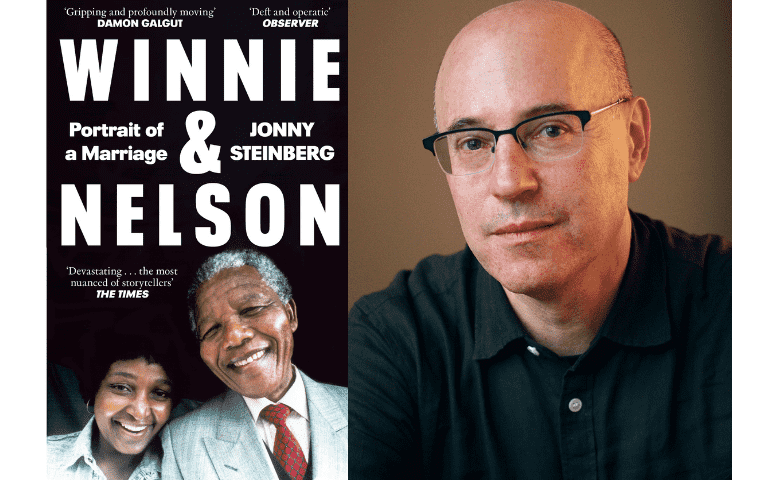
Congratulations on being shortlisted for the Wolfson History Prize 2024 for Winnie & Nelson. How does it feel to be shortlisted and what would winning mean to you?
There is special meaning for me in the fact that this is a history prize. I lived through the latter parts of the tale Winnie & Nelson recounts – the release of Nelson Mandela, the start of the transition from apartheid – and although my role was utterly insignificant, it was such a formative time for me. I was a youth, immature for my age, and was borne through a historic moment by fervently held ideas. I look back with some embarrassment; I was so engaged and yet so unperceptive. To use the tools of history these many years later to revisit those times and to come to a far richer, more meditative understanding of what I lived through has been a profoundly instructive experience. That the product of this journey has been honoured by a panel of historians I so very much admire is quite thrilling.
For someone who is interested in South African history, what wider content – for example books, places, films – would you recommend?
Not Either an Experimental Doll, edited by Shula Marks. It is a mid-century exchange of letters between an aspirant young black woman seeking help, and an older white woman, a British Fabian living in Durban. The exchange begins with such good intentions and yet is quickly mired in horribly unhappy feelings. It cracks open South Africa’s central question, that of race, with an economy both a historian and a novelist can only envy.
Then there’s Phyllis Ntantala’s autobiography, A Life’s Mosaic. Ntantala and Nelson Mandela were students at the same university, Fort Hare, she a couple of years earlier than him. She is of the generation that would sit out apartheid from beginning to end before coming to govern South Africa. Her university student milieu is full of surprises: Shakespeare, good wine, the question of whether women should wear lipstick. And this at an institution in the backlands of 1930s rural South Africa. There is no substitute for these granular records: what people wore, what they ate and drank, what they spoke about in private.
Finally, I would visit the Voortrekker Monument. Built in 1938, a decade before Afrikaner nationalism took power, it is a beacon of the grim purpose that lay ahead.
What does the research process look like for you? What were the key milestones along the way?
Researching and writing Winnie & Nelson has been the most exhilarating experience in my professional life thus far. Until this book, I had worked primarily with oral sources and with participant observation. I would follow a person through their days intermittently for a year or so – a farmer, a career criminal, a refugee – and write a portrait of them. Winnie Madikizela and Nelson Mandela were dead. I couldn’t follow them around. I had only the traces of themselves they’d left in the archives. One of the questions framing the project was: can you know people as well when you’re denied that extended personal intimacy? The answer, to my relief, in this particular instance at any rate, was yes. Nelson Mandela was a stunningly accomplished maker and wearer of masks, a master of disguise. And yet when you’re a long-term prisoner and all you have to keep your wife interested in you is the letters you write her, you show your innards. You just have to. I sat at my desk, thinking, ‘My God, I’m really getting to know these people.’
Was there a particular writer, book or experience that first made you interested in history?
In 1984, when I was a 14-year-old high school student, my history class was assigned a textbook called Gold and Workers by Luli Callinicos. It was a simple, lucid, illustrated account of South Africa’s mineral revolution from a Marxist perspective. Outside the classroom window was apartheid Johannesburg. Inside that book was an account of the social and political forces that had made it. It was my first exposure to the power of materialist history and what happened inside me was the secular equivalent to a conversion experience. I understood for the first time that everyone and everything around me had been made by contingent historical forces, and most especially by the exercise of power. The word ‘revelation’ could not be more apt.
Lulu Callinicos is now in her late 80s. I once told her how much her book meant to me. She nodded inscrutably and changed the subject. The flattery embarrassed her.
Why do you feel it is important to celebrate history writing?
I experienced some of the signal events covered in this book twice, first in person as a fervent student activist, and then, thirty years later, in the archive. I wouldn’t want to say anything as starry-eyed as that history is the path to truth. But I did discover the enormous power of the tools of history to illuminate my younger self, and what a rewarding discovery it was.
Read an extract from Winnie & Nelson: Portrait of a Marriage.


