
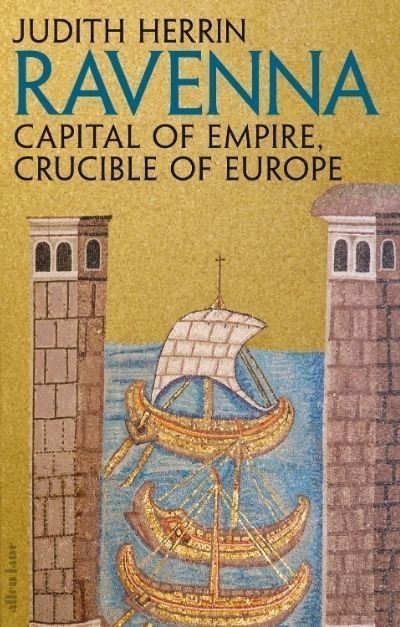
‘Ravenna:
Capital of Empire, Crucible of Europe’
Judith Herrin
Allen Lane
In 402 AD, after invading tribes broke through the Alpine frontiers of Italy and threatened the imperial government in Milan, the young Emperor Honorius made the momentous decision to move his capital to a small, easy defendable city in the Po estuary – Ravenna. From then until 751 AD, Ravenna was first the capital of the Western Roman Empire, then that of the immense kingdom of Theoderic the Goth and finally the centre of Byzantine power in Italy.
In this engrossing account Judith Herrin explains how scholars, lawyers, doctors, craftsmen, cosmologists and religious luminaries were drawn to Ravenna where they created a cultural and political capital that dominated northern Italy and the Adriatic. As she traces the lives of Ravenna’s rulers, chroniclers and inhabitants, Herrin shows how the city became the pivot between East and West; and the meeting place of different cultures. The book offers a fresh account of the waning of Rome, the Gothic and Lombard invasions, the rise of Islam and the devastating divisions within Christianity. It argues that the fifth to eighth centuries should not be perceived as a time of decline from antiquity but rather, thanks to Byzantium, as one of great creativity – the period of ‘Early Christendom’. These were the formative centuries of Europe.
About the author
Judith Herrin is the Constantine Leventis Visiting Senior Research Fellow at King’s College London.
2021
Shortlist
- An illuminating history of Europe from the 5th to 8th centuries as seen through the lens of an Italian city. This book is magisterial
and fascinating.
Wolfson History Prize judges


