
Read the 2023 Wolfson History Prize shortlist
The Perils of Interpreting
by Henrietta Harrison
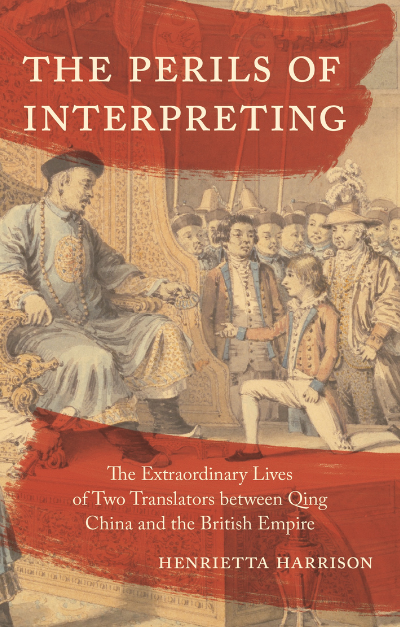
In The Perils of Interpreting, Henrietta Harrison explores how the British Empire and Qing China saw each other in the 18th century, told through the lives of two interpreters. The following excerpt, extracted from the introduction, provides a glimpse into what you can expect from the book.
An extract from The Perils of Interpreting: The Extraordinary Lives of Two Translators between Qing China and the British Empire
Early one morning in the late summer of 1793, George Macartney Earl of Lissanoure, Britain’s first ambassador to China, dressed in the robes of the Order of the Bath with ostrich plumes nodding over his head, knelt before the Qianlong emperor, and held up in both hands above his head a gold box set with diamonds containing a letter from George III.[1] Qianlong was the descendant of Manchu warriors who had conquered China in the seventeenth century. He spoke Chinese and Manchu and was proud of the fact that he could speak enough Mongol, Tibetan, and Uyghur to receive envoys from those areas without the need for an interpreter, but on this occasion an interpreter was essential.[2]
Macartney, who had made a grand tour of Europe in his youth, spoke in Italian. His words were expressed in Chinese by a younger man kneeling behind him, who had given his name as Plum and was dressed in a British uniform and a powdered wig, but was in fact Li Zibiao a Catholic from China’s far northwest.[3] Li had been educated in Naples and he spoke Chinese simply, rather than in the formal language of the court, but with deep respect for the emperor and a certain attractive sincerity that was characteristic to him. When he turned to Macartney he conveyed the emperor’s remarks in elegant formal Italian. The emperor listened to a brief speech, asked a few polite questions, and presented Macartney with a jade sceptre.
When Macartney withdrew, his place was taken by his deputy George Leonard Staunton, a Jesuit-educated Protestant Irishman who was an enthusiast for the scientific discoveries of the age, a follower of Rousseau, a slave owner, a supporter of the recent French Revolution, and Macartney’s long-standing friend, secretary, and henchman. The great project of Staunton’s life was the education of his son, twelve-year-old George Thomas, who now knelt beside him. Li still interpreted, this time into Latin, but George Thomas could understand both sides of the brief conversation: his father had been speaking in Latin to him since he was three, and since his first meeting with Li the previous year George Thomas had also been studying Chinese. When the emperor asked if any of the British could speak Chinese, his chief minister Heshen, who had met Staunton earlier and had a gift for knowing what might amuse the elderly emperor, told him that the boy could speak a little and called him forward. George Thomas was shy, but when the emperor took a yellow silk purse that was hanging at his waist as a gift, he managed to get out a few words of thanks in Chinese.[4]
From beside the throne three of the most powerful men in the land looked on: the prince who would soon come to the throne as the Jiaqing emperor, Fukang’an, the emperor’s favourite general who had recently returned from a successful campaign against the Gurkhas in Tibet, as well as Heshen, who controlled the empire’s finances. There was also Songyun, a Mongol who had originally trained as a Manchu-Mongol interpreter and had just arrived back from the northern frontier where he had been renegotiating the Second Commercial Treaty of Khiakta with the Russians. After the audience and the banquet that followed, Qianlong ordered Fukang’an, Heshen, and Songyun to give Macartney a tour of the gardens, and while Macartney found Heshen evasive and Fukang’an arrogant, he had served in Russia himself and enjoyed Songyun’s enthusiastic questions about Russian politics and government.
This is one of the most famous moments in the history of China’s encounter with the West, and the Qianlong emperor in history, as in life, has always dominated the scene. He was in his eighties at this time, simply dressed in dark robes, sitting cross-legged on his throne, but he had been the autocratic ruler of a vast empire for nearly fifty years. Even Heshen and Fukang’an knelt down when they spoke to him, and he liked to be complimented on the fact that his was one of the most glorious reigns in Chinese history: with rapid population growth after the century of warfare that had sur- rounded the fall of the previous dynasty, agriculture and trade were flourishing, the Qing empire had reached its greatest size with the completion of the campaigns against the Mongols and Zunghars in the northwest, and the arts and scholarship were flourishing under his patronage. Far away on the south coast of China, Europeans had been drawn in by their desire for China’s manufactures: fine silk and porcelain that could still not be replicated in Europe. More recently the trade with the British had boomed as Europeans and Americans acquired a taste for tea, a crop grown only in China.
After the audience Qianlong decisively refused the British requests for a resident ambassador in Beijing and an island off the coast as a trading base. Soon people in Europe were saying that he had done so out of anger that Macartney had merely knelt on one knee, rather than bowing his head to the ground nine times in the full court ritual of the kowtow.[5] Ever since, Qianlong has been blamed for the failure of the embassy: as the Son of Heaven, who claimed to be ruler of the civilised world and knew nothing of rising British power, he had failed to realise that Macartney was anything more than an envoy sent by a distant king to bring him tribute.
[1] Macartney, George. An Embassy to China Being the Journal Kept by Lord Macartney during His Embassy to the Emperor Ch’ien-lung 1793-1794. Edited by J. L.Cranmer-Byng. (London: Longmans, 1962), 122-23; G. L. Staunton, An Authentic Account of an Embassy from the King of Great Britain to the Emperor of China. 2 vols. (London: W. Bulmer, 1797), 2:229-34.
[2] Qing Gaozong (Qianlong) yushi shiwen quanji, 9:581; Evelyn S. Rawski, The Last Emperors: A Social History of Qing Imperial Institutions (Berkeley: University of California Press, 1998), 6.
[3] India Office Records [IOR] G/12/92, Macartney to Dundas, 9 Nov. 1793; Archivio Storico di Propaganda Fide [APF], SOCP 68:623 Ly, 20 Feb. 1794.
[4] Sir George Leonard Staunton Papers, Diary, 14 Sept. 1793. British Library.
[5] Barrow John. Travels in China, (London: T. Caddell & W. Davies, 1804), 7.


