
Read the 2023 Wolfson History Prize shortlist
Resistance
by Halik Kochanski
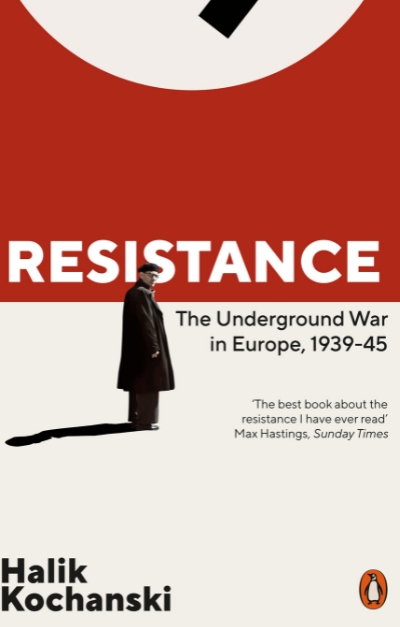
In Resistance, Halik Kochanski presents a remarkable history of pan-European resistance to the Nazis. The following excerpt, drawn from the first chapter of Part One: ‘Why Resist?’, provides a glimpse into what you can expect from the book.
An extract from Resistance: The Underground War in Europe, 1939-45
From the perspective of resistance it is essential to begin the narrative before a single shot had been fired in the Second World War, with the German-inspired dismemberment of Czechoslovakia in March 1939 and the Italian invasion of Albania a month later. Both these occupations reveal a great deal about the rationales lying behind the Axis desire for predominance in Europe, how they intended to rule the countries they conquered, and how the native people were likely to respond.
Czechoslovakia was a post-First World War ‘successor state’, born out of the collapse of the Austro-Hungarian Empire and the defeat of Germany. It was an artificial construct, based around the Czech lands which had formed the kingdom of Bohemia in the fourteenth century but had since then been under the domination of the Austrian Habsburgs, coupled with the Slovaks and Ruthenes who had been part of Hungary since the eleventh century. In addition, the northern part of the country, the Sudetenland, contained a large number of Germans, and the area around Teschen was disputed between the Czechs and the Poles. In the interwar period the country had to face the challenge of drawing together the predominantly industrialized and Protestant Czechs with the dominantly Roman Catholic and largely agricultural Slovaks.[1] A factor in Hitler’s popularity in Germany was his determination not just to reverse the territorial losses forced on Germany by the 1919 Treaty of Versailles but to argue that Germany also had the right to include all Germans residing outside the country in an expanded Reich. The Great Powers had raised no objection to the 1938 Anschluss with Austria, so Hitler now turned his attention to demanding the incorporation of the Sudetenland within the Reich, and with the Munich Agreement of September 1938 he achieved his aim.
The loss of the Sudetenland was a death blow to Czechoslovak independence since it meant the loss of nearly a third of its territory, all of her modern fortifications, and a portion of her industry. It revealed the impotence of the Great Powers to stand up to Hitler. Only the Soviet Union had appeared ready to defend Czechoslovak territorial integrity and these lessons were not forgotten during the Second World War. The loss of the Sudetenland fundamentally undermined the ability of the rest of Czechoslovakia to remain an independent state. The Germans and Slovaks now combined forces to weaken the country further from the outside and inside. For the Germans, acquiring the rump of Czechoslovakia represented the first stage in achieving their long-term aim, that of expanding German Lebensraum – living space – at the expense of the Slavs living in ‘Germanic’ territory. The Slovak leader and a Roman Catholic priest, Jozef Tiso, met Hitler on 13 March 1939 to discuss the possibility of establishing an independent Slovak state with German support. On the following day, Tiso issued a declaration of Slovak independence. At his trial in March 1947 he argued: ‘Without the pressure exercised by Hitler, the Slovak Diet would never have voted in favour of the independence of Slovakia.’[2] Hitler had ordered the chief of the Wehrmacht, Field Marshal Wilhelm Keitel, to prepare the army for invasion of Bohemia and Moravia as early as December 1938: ‘on the assumption that no appreciable resistance is to be expected’.[3] He now summoned the Czech president, Emil Hácha, to Berlin and during all-night negotiations effectively bullied him into accepting the German occupation of Bohemia and Moravia in line with Hitler’s ‘intention of taking the Czech people under the protection of the German Reich and of guaranteeing them an autonomous development of their ethnic life as suited their character’.[4]
German troops crossed into Bohemia and Moravia at 6 a.m. on 15 March. Prague Radio ordered the population not to resist. Peter Wilkinson, a British intelligence officer stationed in Prague, witnessed the German entry into the city:
It was miserable weather; wet snow was falling and the sky was heavily overcast. The civilians who watched the proceedings on their way to work looked utterly defeated and gazed blankly as the troop carriers went by with the Germans, in smart uniforms and without greatcoats despite the freezing weather, sitting upright with their rifles between their knees. Some of the older people were in tears and the children on their way to school looked on goggle-eyed but there was no sign of any hostile demonstration; everyone seemed completely cowed.[5]
On the evening of 16 March, Hácha broadcast to the nation that the last twenty years of Czechoslovak independence had ‘proved to be a short episode in our national history’ and urged the people to accept the new state of affairs and their new masters.[6] Unnoticed at the time, the British helped the head of Czech intelligence, Colonel František Moravec, to fly himself and eleven of his most prized colleagues out of the country. From exile the former president, Edvard Beneš, offered a very different perspective: he would fight diplomatically for the restoration of the independence and territorial integrity of Czechoslovakia, and one of his tools would be support for resistance. But this lay in the future and for the time being it was apparent to the Czechs that only a major war could change the status of their country and offer the hope of an end to the German occupation.[7]
[1] M. Macmillan, Peacemakers (2001), 242–53.
[2] J. Mace Ward, Priest, Politician, Collaborator: Jozef Tiso and the Making of Fascist Slovakia (Ithaka, NY, 2013), 181-2; J. Lettrich, History of Modern Slovakia, (1955), 133.
[3] Documents on German Foreign Policy, D, IV, 186.
[4] Documents on German Foreign Policy, D, IV, 270.
[5] P. Wilkinson, Foreign Fields: The Story of an SOE Operative (1997), 58.
[6] V. Mastny, The Czechs under Nazi Rule: The Failure of National Resistance, 1939-1942 (New York, 1972), 58.
[7] Consul General Linnell to chargé in Berlin, 14 April 1939, in G. Kennan, From Prague after Munich: Diplomatic Papers 1938-1940 (Princeton, NJ, 1968), 117-18.


