
Read the 2023 Wolfson History Prize shortlist
Vagabonds
by Oskar Jensen
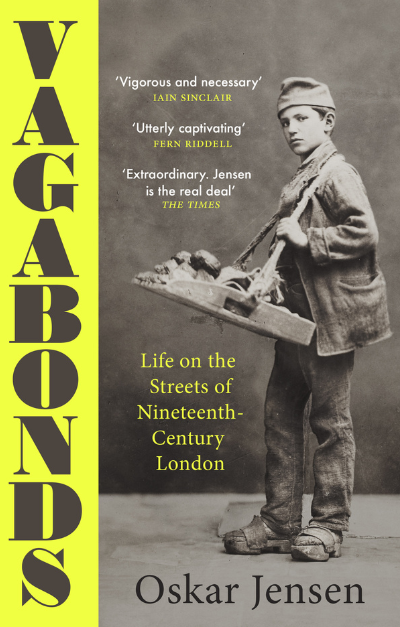
Vagabonds uses first-hand accounts to evoke the streets of 19th-century London, with a narrative woven with the voices of the city’s poorest and most resilient residents. The following excerpt, extracted from the book’s introduction, provides a glimpse into what you can expect from this evocative history from Oskar Jensen.
An extract from Vagabonds: Life on the Streets of Nineteenth-Century London
Our story starts, like every record of human life, with a birth. November 1787: ‘a deserted, solitary, and otherwise unoccupied chamber in the neighbourhood of Gray’s Inn’. It is half-past three in the morning and in London’s legal district, the lawyers are asleep. All the same, doors are being knocked on. One is that of a disreputable actress, Charlotte Tidswell. Shaken from the arms of her lover, Moses Kean, by one of his brothers – Aaron? Edmund? – she is summoned to the aid of her friend Mary Ann Carey in Chancery Lane. ‘Nance Carey is with child’, the father-to-be informs her. ‘With child’ is putting it mildly – Carey’s waters have broken. Years later Tidswell recalls, ‘We asked if she had proper necessities, and she replied, “No, nothing;” whereupon [my aunt] Mrs Byrne begged the loan of some baby clothes’.[1] Armed with rags and blankets, the two women help Carey up Gray’s Inn Road, where Carey’s father has an empty room. It is bare and dank, but it will serve. It is not as if the women have a choice.
Mary Ann Carey is a hawker, a vagrant. Born into a talented if hapless family of theatre-makers – her father is a jobbing playwright; her grandfather wrote some of the most acclaimed songs of the eighteenth century – she ran away from home at fifteen to try her luck with a company of strolling players. Luck is a rare commodity in the Georgian street, however, so she spends rather more of her time selling flowers, powders and pomades, going door to door. Seduced and abandoned by one of the Kean brothers, she is still in her early twenties when we find her in childbirth in a bare room on Gray’s Inn Road. You can imagine the cries carrying, stirring solicitors snugly abed – cries that mingle, come the morning, with others at a shriller, more startled pitch. How long and arduous the labour, we have no idea. But Carey survives, and so does her boy.
Carey is lucky: she has people to help her, a network. This is less unusual than you might think for a street seller, many of whom were woven into their local communities. But then again, she is a travelling hawker, not tied to one place, and within months – perhaps as soon as she has recovered – she is off again, ‘into the country to resume her wanderings’, leaving her baby Edmund in the care of Charlotte Tidswell and Moses Kean. According to one story, he will be lost and found again before she returns, ‘left in a dark doorway, cold, hungry, and desolate’, starving in Soho in 1789. But the boy is a child of fortune. We will see him again.
This book tells the story of life in the street. But even in Georgian London, children were not born in the street, even if they were the children of vagrants. There was always a room, a bed, a cellar, a workhouse. The birth of Edmund Carey, later known as Edmund Kean, is straight out of a melodrama – the desperate mother in the November night, the knock at the door. Perhaps even a baby on a doorstep. But the door opens. The infant’s first glimpse of the world is an interior one.
This raises three questions that I hope this chapter will answer, as we follow these infants from birth through to self-aware childhood. First: if those who lived and worked on the streets were not born there, where were they born – and what conditions marked out the early days of their existence? Second, by what strange or sorry paths did they come to the street, from an indoor world of rooms and roofs? Third, and most perplexing of all – remember, we are still talking of very small children – what on earth did they do once they got there?
[1] Tidswell is apparently quoted in Frederick W. Hawkins, The Life of Edmund Kean. From Published and Original Sources, two vols (1869), Vol. 1, 4. The opening pages of this volume include much of the detail on Kean’s early life and are very harsh on Mary Ann Carey. An earlier account, W.B. Procter, The Life of Edmund Kean, two vols (1835), disagrees with Hawkins in many particulars; it seems unlikely that these issues will ever be cleared up.


