
Read the 2024 Wolfson History Prize shortlist
‘Courting India’
by Nandini Das
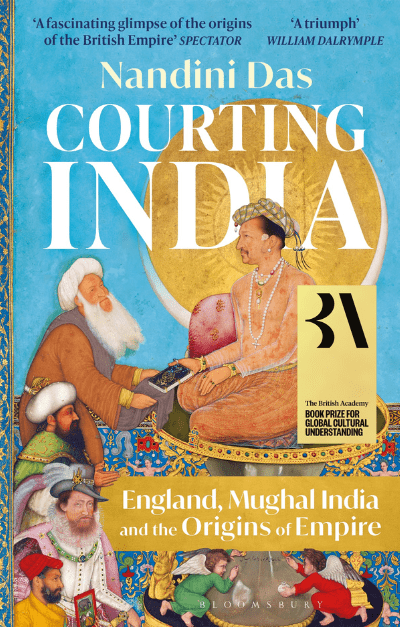
Courting India is a profound and ground-breaking new history of one of the most important encounters in the history of colonialism: the British arrival in India in the early 17th century.
An extract from Courting India: England, Mughal India and the Origins of Empire
It was the kind of day you were meant to remember. When the people of London woke up on 15 March 1604, the sky was grey and overcast. The sun ‘had overslept himself’, Thomas Dekker would write. Dekker, a playwright, had a personal reason to pay attention to the weather. He had a stake in the day’s events going well, since he had helped to create them. So it was no doubt something of a relief to him that the clouds had done nothing to stop a ‘world of people’ from descending on London. Every vantage point was filled. Men and women crowded the streets and children clambered on to market stalls to peer over their shoulders. The rich and the elderly, those who did not want to risk the noise and stench of the streets and had the means to avoid it, commandeered the windows of houses that offered a good view of the festivities. Those with foresight had gone to even greater lengths. A pedestrian looking up could see heads peeking out where some wily householders had removed their glass windows so that they could get a better view. London was waiting to greet its king.
James VI of Scotland, nephew to Elizabeth I and son of Mary, Queen of Scots, had been proclaimed king hours after Elizabeth’s death on 24 March 1603. Under normal circumstances, the new monarch’s ceremonial entry into his new capital city would have taken place soon after his coronation, but even kings have no control over the plague. We have Dekker to thank for a report on that too. The ban on all public gatherings to stop the spread of the infection had closed the theatres down, taking his livelihood with it. Like many of his contemporaries, Dekker found himself desperately trying to scratch out a living. His first attempt at that was a dark, whimsical, often savage little pamphlet called The Wonderfull Yeare, which describes a country teetering between despair and hope. First was the shock of the queen’s death for a generation ‘that was almost begotten and born under’ Elizabeth and ‘never understoode what that strange outlandish word Change signified’. Then came the formal announcement of the new king. ‘Upon Thursday it was treason to cry God save king James king of England,’ Dekker noted with his playwright’s eye for a dramatic turn, ‘and upon Friday hye [high] treason not to cry so.’ Plague came soon after and transformed London into a nightmarish city under siege. The Wonderfull Yeare is that unlikely thing, a plague jestbook, one to read when the only thing to do if you are not to give in to damning despair is to laugh at human folly. Its pages are full of desperate people trying to escape inevitable death, and carrying death with them as they ride into the countryside. It echoes with the noise of lamentations, of mothers weeping over dead children, and orphans weeping over parents. Its London is eerily quiet. Entire streets and neighbourhoods are emptied out. Over 30,000 people died in London alone in that plague year. The city turned into a ‘vast silent Charnell house’, its pavements strewn with futile preventatives like ‘blasted Rosemary: withered Hyacinthes, fatall Cipresse and Ewe [yew], thickly mingled with heapes of dead mens bones’. The air was thick with the ‘noysome stench’ of the sick and the dead.
On that overcast day in May a year later, however, the city breathed freely again. The pestilence had exhausted itself. Instead of weeping and lamentations, music sung by a choir of 300 children greeted the king as he set off from the Tower of London for the Palace of Westminster under the curious gaze of his new English subjects. Instead of the stench of death, there was the sour press of living, breathing bodies, and the rising din of their excitement. In time-honoured tradition, the conduits at Cornhill, Cheapside and Fleet Street, which usually supplied water to Londoners, had been set to flow with claret wine to mark the auspicious occasion. It mingled with the dust where the dead had gathered so recently, staining the shoes and hems of gowns of drunk and exhausted crowds, and muddying the hoofs of the horses of the king’s retinue. James was only thirty-eight, but his thin, red-bearded face, with bags under the eyes and a receding hairline that he preferred to hide under a hat, made him look older. Dressed in clothes richly embellished with pearls and jewels, he rode under a canopy held by sixteen gentlemen of his Private Chamber, looking dour and uncomfortable. His queen, Anna of Denmark, seemed far more at ease. She sat on a silver and crimson open litter, dressed in white and equally bejewelled. Her expressive dark eyes scanned the crowds as she smiled and waved at the bystanders. Before and after them snaked a long line of courtiers and knights, members of the peerage, trumpeters and royal servants, over a thousand of whom had received yards of scarlet cloth to be made into livery to mark the occasion. The traditional coronation route of English monarchs took James right through the City’s financial heart. As the crowds followed the winding route, they were bound to get stuck at bottlenecks at several points where the king and the entire procession slowed to take in the elaborate structures spanning the streets, decorated like Roman triumphal arches. The much later, nineteenth-century Marble Arch in London gives us some idea of the scale of these constructions, although the tallest of the arches designed by the joiner and architect, Stephen Harrison, was double its height, and painted in the brightest colours. Funded by the merchants of London, these were more than just expensive street decorations. Each gateway guided the monarch through a virtual grand tour of his realm and the world beyond: each an elaborate compliment, but also a discreet nudge, pushing the new king towards a future that his subjects wanted to see fulfilled. Dekker, along with other well-known contemporary writers such as the playwrights Ben Jonson and Thomas Middleton, had written dramatic speeches explaining the show.
About halfway through the route was Cheapside. In 1912, labourers working on a building site would uncover the famous Cheapside Hoard, the largest cache of Elizabethan and early Stuart jewellery ever found, which reminds us that the ‘cheap’ in the name is far from a comment on the price of things sold there. It comes from the Old English ceapan, ‘to buy’, because Cheapside was the city’s richest shopping thoroughfare, where the wealthiest of London conducted their business. At one end of this thoroughfare is Lombard Street, with its long tradition of housing the richest of the foreign merchant elite, and the gleaming Royal Exchange, London’s first ‘Bourse’ or Stock Exchange and shopping mall combined, designed with the express intention of rivalling the Antwerp Stock Exchange. Even now the signs of its history remain in the great buildings that line the sides: major UK-based banks like Barclays and Lloyd’s had their operations governed from here till well into the twentieth century. At the other end, there is a tangle of streets now full of cafés and glass-fronted office buildings. Their names – Honey Lane, Milk Street and Bread Street – betray their medieval market roots, although in Dekker’s times the bit between Bread Street and Friday Street was more famous for its glittering goldsmiths’ shops, London’s famous ‘Goldsmith’s Row’.
The sixty-foot gate that Stephen Harrison had placed here was strikingly different. Two ‘great pyramids’ or obelisks flanked it on either side, and palm-leaf-wielding figures looked down from the top. As he stood at the wide gate at base, an exhausted James I, visibly uncomfortable in the press of people, had to tip his head back to see the ‘legend’ inscribed in large letters over the entrance. ‘Nova felix Arabia,’ it declared, depending on the scholarly king’s biblical knowledge to announce itself a new ‘Arabia Felix’, the site of the Garden of Eden. Britannia presided over this arch, but she was different from her usual depictions. This was ‘Arabia Britannia’, the symbol of Britain’s future prosperity, rejoicing in the king’s arrival. Perched on a gallery attached precariously to the Cheapside Cross, the Recorder of London, one of the most senior City officials, had to shout over the noise of the crowds to welcome James. His words echoed the familiar rhythm of the Songs of Solomon: ‘Come, therefore, O worthiest of kings, as a glorious bridegroom through your royal chamber’. The sceptred isle was open for business under a new king.


