
Read the 2024 Wolfson History Prize shortlist
‘Our NHS’
by Andrew Seaton
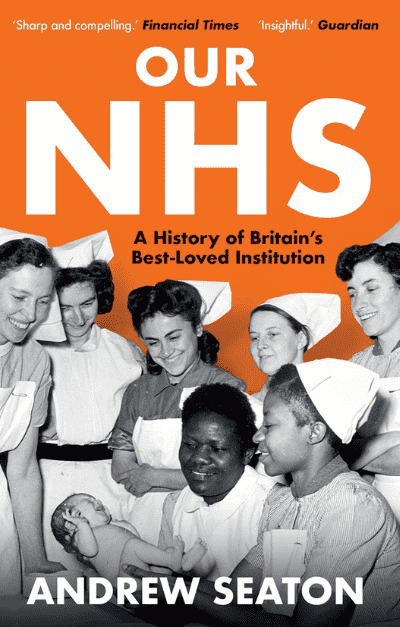
Our NHS is an engaging, inclusive history of the NHS, exploring its surprising survival – and the people who have kept it running.
An extract from Our NHS: A History of Britain’s Best-Loved Institution
Preface
Like almost all people born in Britain, I was delivered by someone working for the National Health Service (NHS). Growing up, I had an extensive set of connections to the service that were far from unique. My mother worked as a care assistant in a residential home for the elderly, and then as an NHS hospital cleaner. Two of her sisters were nurses. Later, while at home in Exeter during the vacations from my undergraduate degree, I cleaned the wards of that same hospital.
One day, while mopping a chiropody unit, I paused and watched from afar as a large digger demolished the ward I had been born in. The buildings changed, yet this thing I knew as ‘The NHS’ continued. By training, historians are rarely encouraged to place themselves in their research. The pursuit of pure ‘objectivity’ – in reality, an impossible task – was baked into the discipline’s professionalisation during the nineteenth century. Yet, if you grew up in Britain, it is difficult not to relate oneself with the history of the NHS, which, as my own experiences testify, has touched the lives of nearly everyone in the country since its establishment.
The inspiration for this book came from watching the Opening Ceremony of the London Olympic Games in 2012, where the NHS featured prominently. Why, I wondered, was a medical system so important to projections of British identity? And why had the NHS lasted long enough to take on this significance, when other parts of the postwar welfare state or public industries had fallen away?
Answering these questions required undertaking research beyond the official records of the Ministry of Health held in the National Archives at Kew, and prompted me to explore a range of local collections, activist archives and personal papers. I trawled through folders of documents, tracked down episodes of long-cancelled television programmes, and pored over piles of photos. The resulting book interrogates the history of what is frequently described today in Britain as ‘Our NHS’. It considers the roots of the service, how it modernised and resisted opposition and why it came to take on such prominence. I also discuss the costs of these historical developments. This book is not a mawkish account, driven by ‘loving’ the NHS. The service was not always supported; it could do harm, and its nationalist framing sometimes excluded people. Nor do I offer a declinist interpretation driven by the latest newspaper headlines.
This book is a work of history, not a policy study of the contemporary NHS. The media’s focus on ‘NHS crisis’ – which, of course, stems from real concerns – often obscures the historical picture recounted in these pages, full of surprising continuities or different ruptures than we might expect. I hope I have written a book that does some justice to the significance of this totemic postwar health service and the politics it represents, the people who worked in it and the patients it treated.
Introduction
When June Rosen first met Aneurin Bevan, he was wearing his pyjamas. Just eight years of age, Rosen could not fully grasp her parents’ conviction that this man was about to change the lives of 45 million people. All the same, with the Minister of Health staying as a guest in her home, Rosen helped to bring him breakfast in bed. Suffering from a cold, she was instructed to keep her distance. But even from the doorway, Bevan – the Welsh ex-miner and socialist firebrand – impressed with his shock of silver hair. Later that day, Rosen’s father – a local Labour councillor – drove their visitor to Park Hospital on the outskirts of Manchester for a special ceremony. It was 5 July 1948, and Bevan had made the trip to inaugurate a new institution, the ‘National Health Service’, which promised comprehensive medical care to all citizens, without direct charge.
Seventy-five years later, anyone looking to fill a rainy afternoon can purchase a jigsaw puzzle that memorialises the events of that day. The puzzle’s thousand pieces form a colour painting of Bevan in front of Park Hospital, holding hands with a girl similar in age to Rosen. The Welshman stares imperiously into the distance, flanked by enough doctors, nurses and patients to raise the question of whether anyone is actually left in the hospital. Released in the ‘Nostalgia’ series of the company Falcon Deluxe, the picture offers a harmonious scene of the 1940s, full of smiles, sunshine and racial diversity. This jigsaw is just one instance of the esteem that surrounds the NHS in the early twenty-first century. Over and over again, people across the UK tell pollsters that the service is the thing that makes them ‘most proud to be British’. In an increasingly secular society, the institution is discussed as something akin to a religion.
Our NHS explains why the service came to assume such significance in British life. In doing so, it argues that the social democratic politics that the NHS represents endured well beyond the moment of their supposed demise. This book is a story about how a welfare institution first emerged, modernised, engaged with the world and survived the rise of neoliberalism. These pages differ in tone from both celebratory histories that present the NHS as destined for greatness and dour obituaries charting a terminal descent into ‘privatisation’. Instead, I look at the NHS from the inside out, shifting from the doctor’s consulting room, to the aspiring surgeon travelling across formerly imperial borders, to critics hatching plans for the institution’s replacement, to members of the public baking cakes decorated with the service’s initials.
Our NHS reveals the surprising resilience of a health service that is perpetually in ‘crisis’, yet perennially lasting, offering an account that incorporates those who wanted to tear it down and those who kept it afloat.


