
Read the 2025 Wolfson History Prize shortlist
‘The Mysterious Case of the Victorian Female Detective’
by Sara Lodge
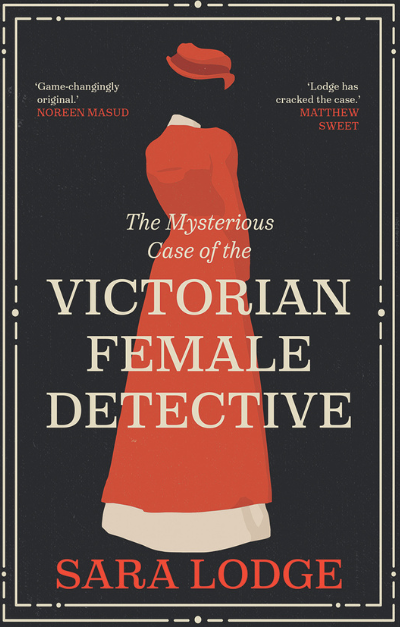
The Mysterious Case of the Victorian Female Detective explores the lives and work of Victorian women detectives. Revealing that women performed detective roles within the police, and were vital to private enquiry agencies, it compares the mythic female detective – who flourished on the Victorian stage and page – with the morally ambiguous world of her factual counterpart.
An extract from The Mysterious Case of the Victorian Female Detective
This story begins, as so many tales of crime do, in a library. In 2012, I was sitting in the British Library in London. The Rare Books Room is a quiet haven at the heart of the noisy, polluted interchange where King’s Cross Station and the fiery Victorian gothic of the St Pancras Hotel converge in a flurry of taxis and suitcases. To enter, you pass a pensive portrait of Charles Lamb, show your card and gain admission. Elderly gentlemen in suit and tie, graduate students in tie-dye: each reader sits, perfectly spaced out from one another, lit by a single desk lamp, in long rows. They are studying first editions of Romantic poetry, sheet music by Satie and Modernist magazines with a print run of only one issue. Considerate typing on laptops fills the room with a sound like gentle rain.
On the desk before me were two racy, rackety titles, both published in 1864. Cheap thrills when they came out, they are now prohibitively expensive. The reason is that these rare books, which pretend to be first-hand accounts, are the first British works of fiction to feature professional female detectives. [1]
The question I was pondering was why? Why did these two books both appear in 1864? What was there in the air of this particular year that led to not one, but two books featuring daring, mature women who make their living as sleuths. Stranger still, why did these books appear to be a flash in the pan? Female detectives, it seemed – from the criticism I was reading – appeared in fiction in 1864 like the first swallows of summer and then went extinct, before emerging again over two decades later in the early 1890s. It was a quandary. The case of the vanishing lady.
First, I picked up The Female Detective by ‘Andrew Forrester’ (a pseudonym for James Redding Ware). More than twenty years before Arthur Conan Doyle’s Sherlock Holmes first appeared in A Study in Scarlet (1887), ‘Miss Gladden’, who is ‘verging on forty’ and is called ‘G’ by the force, solves cases by a variety of deductive methods. She deploys forensic evidence, sending fluff on the clothes of a homicide victim away for analysis and examining the wadding in a gun to discover the reading matter with which the bullet has been padded: a vital clue. She reflects that the English police system ‘requires more intellect infused into it’, that ‘experience shows that the chances of discovery of a crime are in exact inverse proportion to the time which has elapsed since the murder’ and that while men seize facts, they are unable to ‘work out what lies below the surface’. She announces that she is ‘a police-officer’ and claims both that women detectives ‘can educate our five senses to a higher pitch than . . . our male competitors’ and that they ‘can get into houses outside which the ordinary men-detectives could barely stand without being suspected’.
‘Miss Gladden’ is, in other words, a sleuth on a mission. From interview technique to the finer points of keys, she makes a political point of showing that a woman can supply what is lacking and improve what is deficient in the English policing system. Her exploits take her from investigating a headless body in the Thames, the victim of a hit by a European secret society, to considering a child murder: a thinly disguised version of a true crime at Road, in Wiltshire, that had convulsed the nation in 1860.
The other volume, Revelations of a Lady Detective by William Stephens Hayward, was odder still. Its cover featured a woman who was flirting with the viewer, lifting her skirt to show a neatly turned ankle, while smoking a cigarette. The impression was suggestive. Would there be pornographic revelations within? In fact, this female detective keeps her clothes on. But there are cases between the covers that deal in transvestism, underground sects and erotic violence. Not to mention a circus performer who makes a living by biting the heads off rats.
Mrs Paschal, Hayward’s female detective, slips off her crinoline to descend a secret staircase and pursue a countess who by night, dressed as a man, is robbing gold bullion from the vaults of the bank beneath her Belgravia mansion. Mrs Paschal rescues an heiress from an abusive sect of nuns who whip the girl when she refuses to leave them her fortune. She even gets caught in a Mafia shoot-out in a crumbling mill on the Isle of Dogs. The action heroines of modern cop dramas have nothing on her.
Why had two female detective casebooks appeared in 1864? Modern commentators did not, it seemed to me, have a sufficient explanation for this freak occurrence. These two books, it was claimed, had not led to successors. It was curious. Why had the character of the professional Victorian female detective suddenly materialised, then vanished? There were, after all, no real female detectives at this time. Literary critics said so. Historians of the period said so. The police said so.
As I sat in the library, staring into space, I thought of the magician’s trick: the Vanishing Lady. It was a Victorian stage illusion: one of the signature coups de théâtre of magician Joseph Buatier de Kolta in the 1870s. In the trick, a woman sits in a chair before the audience. A cloth is thrown over her. Then she disappears.
Pouf!
People gasp. The audience stares in wonder at the empty chair. The trick was performed by means of a concealed trap door and a wire frame that held the cloth in mid-air while the woman did all the work of sliding silently below, out of sight.
I stared at the chair that contained the Victorian female detective. It appeared to be empty.
Yet, in the magician’s trick, there is always a body breathing; it is just that you have not seen it move. As I gazed into the hushed space of the library, dimly seeing the heads of readers who were not talking but were still very much there, their fingers chattering over the keys, an impudent thought came to me: I don’t believe you.
There. I had said it, if only to myself. I don’t believe in rain without clouds. I don’t believe the magician’s floor is solid. I don’t believe that there were no Victorian women detectives in 1864.
And, with a shuddering creak, a door opened. That led to a staircase. That led to a vault. Inside which was the material of this book.
[1] Several professional female detectives appear at this moment in British fiction. Another ‘first’ is Ruth Trail in Edward Ellis, Ruth The Betrayer or The Female Spy (London: Dick, 1863). Ruth is the protagonist of a pseudonymous, no-holds-barred serial in which she is said to work both for the police, as ‘a female detective – a sort of spy we use in the hanky-panky way when a man would be too clumsy’ – and for ‘a notorious Secret Intelligence Office, established by an ex-member of the police force’, run by Eneas Earthworm. However, there is little consistency to her narrative, in which she is a ruthless villain as well as a spy (‘her life up to now would fill a dozen volumes brim full of villany [sic], and treachery, and crime, and horror!’) and so it is fair to say that she is as a much a mystery as she is a detective.


