
Read the 2025 Wolfson History Prize shortlist
‘Embers of the Hands’
by Eleanor Barraclough
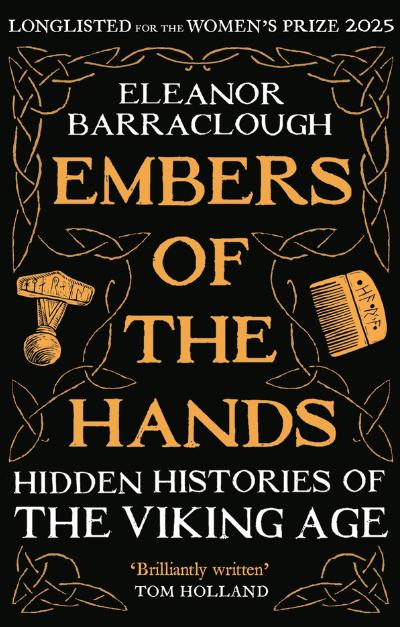
Embers of the Hands is a history of the Viking Age told through the everyday objects of ordinary people.
An extract from Embers of the Hands: Hidden Histories of the Viking Age
We are taught to think of history as a series of canal locks, each period neatly compartmentalised from the one before and after. Stone Age, Bronze Age, Iron Age, Romans, Anglo-Saxons, Vikings, Normans and so on. Quite often the locks are defined by the deaths of rulers, famous battles, the arbitrary ticking over of the centuries. And just as the canal waters of history flow obediently from one lock to the next, so they stay within their geographical bounds. It is neat, and, to some extent, necessary. It is also artificial. In reality, history is more like a great untamed river: a flowing entity, shifting and branching, merging again, wild and unpredictable. Its streams do not always have clear beginnings or endings. Nor do they always stay within the geographical boundaries set out for them on a map. And the ordinary humans bumped and bounced along by its currents do not always know where they are, let alone where the river is taking them.
Where, then, to start a history of the Viking Age? With the shock of fiery dragons and lightning in the skies over Northumberland – or so the Anglo-Saxon Chronicle reports for the year 793 – before Scandinavian raiders descended on the monks of Lindisfarne? Or do we head upstream, and trace the churning waters back in time?
Let’s head back to the Scandinavian homelands, around two thousand years from the present day, to an unassuming Danish bog. Here, thickly squelching carpets and rounded hummocks of moss shade gradually from lime green to rusty orange. Low-lying lakes are framed by spindly birches and willows. In the warmer months, the mirrored pools are spiked with bright yellow flowers of bog asphodel and bladderwort, dotted with white feathery cotton grass. Snipe wade with their needle-long beaks and creaking-bedsprings call, amorous marsh harriers tumble together through the sky. Then the earth starts to tip away, taking with it the warmth and light. New colours appear: the dusty blues and cherry reds of bilberries and lingonberries, the tawny browns and yellows of mushrooms. And with them, creeping cold and damp. Overcast iron skies arrive, and frostlaced water.
For centuries, bogs such as these were gateways between worlds. Shifting landscapes of wet and dry, hanging mists, bubbling marsh gasses, will-o’-the-wisps. Fitting places to commune with the more-than-human forces of this world. Fitting places for sacrifice. The bogs provided sustenance for humans and livestock, black peat for fuel, lumps of bog iron for weapons and tools. But what is taken must be paid for. Clothes, pots, tools, games, weapons, animals, humans. Gifts to the gods on the other side. They all went into the dark: the airless wet spaces and the saturated soil, pickled by acid, their organic matter preserved long after those who cast them into the water. These bogs were wombs for the dead. Some humans were deliberately sacrificed, others perhaps not, but all were delivered into the safekeeping of the water spirits, who immortalised them with shining bronzed skin and coppered hair.
The particular bog we have come to is called Vimose. It is located on Funen (Fyn), the large Danish island between the peninsula of Jutland (Jylland) in the west and the island of Zealand (Sjalland) in the east. It lies roughly on the same latitude as Hadrian’s Wall to the west, and the same longitude as Oslo to the north. Mose simply means ‘bog’. The origins of vi are harder to pinpoint. In the Viking Age, the word vé or ví referred to a ‘pagan sanctuary’ or ‘pagan shrine’. While it is tempting to make the connection and suggest that Vimose means ‘pagan shrine bog’, there are more likely, somewhat marshier possibilities: ‘willowbog’, ‘wood-bog’ or ‘lapwing-bog’.
Squelching about, our fingers find pottery shards and bones, both human and animal. Ancient tools of metal and wood: hammers and tongs, knives and twist-drills, files and fire steels, even anvils. Gaming pieces and scraps of clothing. We find horse trappings and handle-grips of wood and bone and bronze. Iron shield bosses. Bows and arrows hewn from pine. Axes, swords and spear heads. A complete suit of mail armour, its rings clogged with mud. Out they come from the marshy soil, thousands upon thousands of artefacts, often bound together with cloth or string.
The offerings placed in Vimose started out modestly enough in the last century BCE – a few Iron Age pots, food and animal parts. Around the time when BCE ticked over into CE, the first few weapons arrived: a sword and a dozen spear heads. Over time, more spears, swords, shields and belts drifted down through the water, until thousands of weapons lay submerged with other offerings in the mud. This was no unique phenomenon. Around twenty Danish bogs have been found with Iron Age war gear deposits, reaching a peak in the third and fourth centuries. Often there are traces of ritual destruction – the points of weapons bent – as if they had been neutralised, or perhaps ‘killed’ would be a better word, so they could pass over to the other side.
In this bog, we see hints of what was to come as the centuries marched on towards the Viking Age. These offerings are evidence of the increasing militarisation of northern European societies, and the growth of far-reaching connections, alliances and tensions. In the early centuries CE, wealth, power and territory were becoming concentrated in the hands of a few powerful leaders. An elite military class emerged, capable of raising big armies and controlling resources over long distances. Especially in the case of large-scale sacrifices of war gear, it seems likely that the items belonged to unsuccessful invaders from further afield: other parts of Denmark, north from regions of what are now Norway and Sweden, south from parts of what are now Germany and Poland. Their bodies were stripped by their victorious enemies, their belongings repurposed as gifts to the spirits of the marshy waters.


