
Read the 2025 Wolfson History Prize shortlist
‘Survivors’
by Hannah Durkin
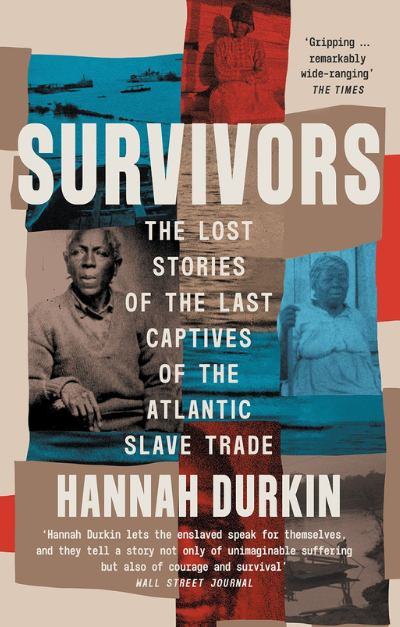
Survivors is an immersive and revelatory history of the survivors of the Clotilda, the last slave ship to land on American soil, whose lives diverged and intersected in profound ways.
An extract from Survivors: The Lost Stories of the Last Captives of the Atlantic Slave Trade
The Clotilda survivors could never hope to forget the horrors of the Middle Passage, but they adopted different ways of responding to the searing traumas and aching losses that stalked them throughout their lives. Polee, the round-faced man with expressive eyes who kept his dark hair and goatee beard into old age, worked to shield his 15 children from the pain he endured as a 19-year-old. ‘Papa was so sweet,’ his daughter Clara Eva Bell Allen Jones remembered shortly before her death in the 1990s. ‘He didn’t tell us nothing bad, because we would have cried.’ Instead, Polee talked constantly of his Yoruba homeland and how much he longed to take Eva and her siblings there: ‘His whole heart’s desire was to take us back to Africa with him.’ When Emma Langdon Roche visited him in the final decade of his life, Polee sought stoically to bury his trauma. His interviewer was not fooled. She saw the haunted look in his eyes. By contrast, Dinah, the small 13-year-old who described seeing dazzling red objects on the Clotilda, recounted the injustices of her experiences daily right up to her death in 1933. She forced her descendants to gather around her and beat them if they did not pay attention, so determined was she that they should neither forget what she had endured nor the land from which she came. But not even Dinah’s daily re-enactments of her agonies could begin to impart the vicious loss of innocence the child endured when she arrived on the Clotilda. Once on board the ship, the young girl’s confusion was swiftly replaced by the brutal realization that she was trapped. Those vibrant red colours that she remembered as having lured her onto the schooner were drowned out by an unyielding darkness as she was forced into the hold.
The captives’ arrival on the Clotilda on 24 May 1860 brought both mortal terror and existential dread. Their imprisonment marked the beginning of a permanent estrangement from their homelands and heritages. Bereft of their freedom and of all but the body adornments that defined their ethnic identities, and ripped from almost everything and everyone that had given their lives logic, they were left in a crowded, sightless and ever-moving space. Kossula reported being chained to the floor of the hold. It’s likely that only the young men were shackled, although 15-year-old Abaché, 12-year-old Redoshi and a dark-skinned 15-year-old girl with three deep marks running from the top of her nose to her cheeks named Zuma indicated that the women and some of the children might have been chained, too. Regardless of how many were restrained, all were horribly confined in a space measuring no more than seven feet in height.
Thus began the shipmates’ irreversible journey. For the next 13 days, the Africans were locked in the pitch-black and poorly ventilated hold normally used to carry sugar, lumber and cotton, and found themselves wallowing in their own vomit and excrement. Most of them had never seen the sea before, let alone travelled on it. The water seemed to stretch away endlessly, raising in the young Africans countless questions but offering up none of its mysteries. Where did it lead? Did it lead anywhere at all? The shipmates’ fears that they would never see land again were exacerbated by their hellish surroundings. The deafening sound of the waves beating against the boat, punctuated by the screams and groans of their fellow prisoners, left them in constant terror that the ship would keel over. Kossula expressed his suffering many decades later: ‘Oh Lor! I so skeered on de sea! De water, you unnerstand me, it make so much noise! It growl lak de thousand beastes in de bush. De wind got so much voice on de water. Oh Lor’! Sometime de ship way up in de sky. Sometime it way down in de bottom of de sea. Dey say de sea was calm. Cudjo doan know, seem lak it move all de time.’
Most of the shipmates were younger than 20. The Atlantic voyage must have been especially petrifying for those many child captives, some of whom – like Matilda and another little girl named Nannie – were as young as two and four years old. Few were accompanied by their parents on the voyage. Some did not even have extended family members to comfort them. One 14- or 15-year-old girl named Uriba was so terrified that she wept for days. Her shipmates tried in vain to reassure her despite their own agonies. Even 40 years later, Abaché, the girl with the centre parting, who was understood by Uriba’s descendants to be Uriba’s sister, was unable to recall the Middle Passage experience without crying. For those uninitiated young Africans, the transatlantic journey was the most perverse rite of passage into adulthood. There would be no banquets with wine and roast meat such as Kossula received when he learned the secret of the Oro, no kinfolk to mark their journey. Two-year-old Matilda’s solitary facial mark, which spread from the bridge of her nose and then branched in two directions down her left cheek, would serve as a permanent reminder of the father she never knew and the West African childhood that was arrested almost as soon as it began. Her 10-year-old sister Sally’s face bore the same ‘crow-foot’ pattern as well as four additional marks, marks Matilda would also have received if she had been allowed to grow up in Tarkar. Redoshi’s crow-foot marks stood out on her high, wrinkled cheeks in the days before her death as the last visual evidence of her long-lost childhood.


