
Read the 2025 Wolfson History Prize shortlist
‘The Eagle and the Hart’
by Helen Castor
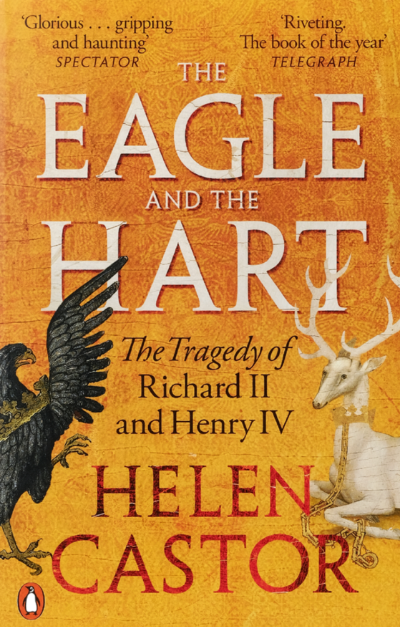
The Eagle and the Hart chronicles the lives and reigns of Richard II and Henry IV, two cousins whose rivalry brought their nation to the brink of disintegration – and back again.
An extract from The Eagle and the Hart: The Tragedy of Richard II and Henry IV
Richard of Bordeaux and Henry of Bolingbroke were first cousins, born in 1367 just three months apart. They were ten years old when Richard became king of England. They were thirty-two when, in 1399, Henry overthrew him to become king in his place.
It was a shocking and intensely dangerous moment. The authority of the crown, contemporaries believed, was instituted by God to rule the kingdom and its people. England’s sovereign was required to be both a warrior and a judge, to protect the realm from external attack and internal anarchy. To depose the king, therefore, was to risk everything – worldly security and immortal soul – by challenging the order of God’s creation. Such devastatingly radical action could never be justified unless kingship became tyranny: rule by arbitrary will rather than law, threatening the interests of kingdom and people instead of defending them. Even then, could anyone but God rightfully remove a sovereign He had anointed?
Before Richard and Henry were born, that question had been answered in the affirmative only once in England in the 300 years since their ancestor William the Conqueror won his crown on the battlefield at Hastings. During the early decades of the fourteenth century, their great-grandfather Edward II had prioritised his favourites over the needs of his kingdom so consistently, to such appalling effect, that he undermined the rule of his own law. His wife led the resistance that, in 1327, put his son on the throne in his place.
But Richard’s deposition in 1399 was the first in which the crown did not pass to an unequivocally legitimate heir. Richard had birthright on his side, and a profound belief in his own God-given majesty; beyond that, he lacked all qualities of leadership. Henry had everything Richard lacked, all the qualities of a sovereign, bar one: birthright. A king who was a tyrant was replaced by a king who was a usurper. In his attempt to preserve the kingdom, Henry had to undo the sacred authority of the crown and then try, somehow, to reconstruct it in his own image.
* * *
When I first began thinking about this book, I knew it would be a study of the psychology of power. Richard and Henry make a fascinating pair – so closely related by blood, such utterly different men – whose intertwined lives formed an extraordinary and fateful moment in England’s history. But for a historian, thoughts and emotions aren’t easy to interpret without the benefit of private letters, diaries, memoirs or any other means of access behind the closed doors of a public life. At a distance of 600 years, drawing a psychological portrait is only made possible by joining scattered dots, rather than tracing a continuous line. I’ve set out to join dots from the surviving records of Richard and Henry’s lives into a coherent representation of two very human beings: to investigate not only what they did, but why they did it, and how they came to be the men they were. The endnotes to the book show the contemporary sources from which I’ve worked. There’s plenty of room within and between them for alternative perspectives, but in the pages that follow you’ll find the Richard and the Henry that I’ve come to see.
I also knew that, unlike some stories I’ve previously told, almost all of the book’s protagonists would be male – not only because the world of the fourteenth century took it for granted that leaders must be men, but because the moment in which Richard and Henry lived was a moment of political masculinity in crisis, a moment at which the war that had shaped the experiences of the two generations before them began to fail. Still, I hope that the women in this history won’t go unnoticed: many of them very young, some finding a kind of agency, personal or political, within a highly constrained existence, and almost all facing physical risk in childbirth just as much as their male contemporaries confronted danger on the battlefield.
What I didn’t foresee was that, during the years I’ve spent in Richard and Henry’s company, the conflict between them would come to feel so topical. To twenty-first-century eyes, the political world of the middle ages always combines the strange and the familiar. Fourteenth-century England was a remarkably centralised state with a complex bureaucracy, a sophisticated judicial system, and representative parliaments in which taxes were granted and statute law made – but it had no police force or standing army. The authority of the state relied instead on the private power of the aristocracy, the great landowners whose estates across the country gave them not only wealth but control over people. England was a nation with its own distinct language, culture and history – but its frontiers with its neighbours of France, Scotland and Ireland were sites of constant conflict, wars shaped by feudal hierarchies and dynastic claims. All of these circumstances gave profound significance to perceptions of legitimacy in government: the relationship between principles of law and their practical enforcement, and the balance between individual interests and the common good.
And that, for me, is what makes the tragic history of Richard II and Henry IV so chillingly resonant. Theirs is a story about what happens when a ruler demands loyalty to himself as an individual, rather than duty to the established constitution. When he seeks to create his own reality rather than concede the force of verifiable truths. When he demands that his own will should trump the rule of law. When he recognises no interests other than his own. It’s a story about the terrifying unpredictability of unfolding political crises; about the interplay of conflicts within states and between them; about the ways in which authority can be bent, shaped and broken. Its drama is rooted in family and dynasty, constitution and country, and its themes of power, legitimacy, and the limits of rule and resistance are as urgent now as they have ever been.
This is the story of how a nation was brought to the brink of catastrophe and disintegration – and, in the end, how it was brought back.


