
Read the 2025 Wolfson History Prize shortlist
‘The Gravity of Feathers’
by Andrew Fleming
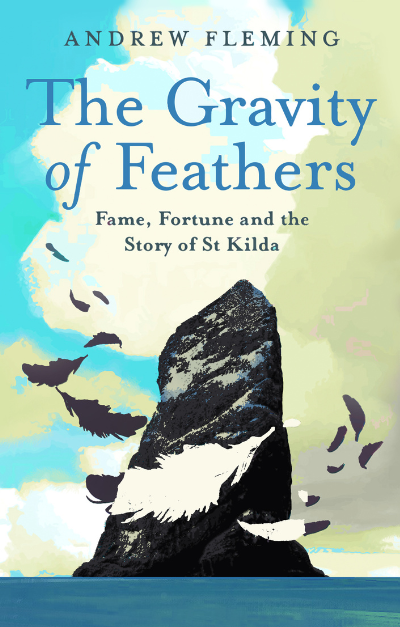
The Gravity of Feathers tells the absorbing and eventful story of St Kilda from earliest times, up to the evacuation and its aftermath.
An extract from The Gravity of Feathers: Fame, Fortune and the Story of St Kilda
Scanning the horizon from the Western Isles of Scotland, looking far out over the Atlantic, it’s possible to make out, weather permitting, the faint and jagged silhouette of a group of islands – the celebrated World Heritage Site of St Kilda. Hirta, the only habitable island in the archipelago, covers only 6 square km; yet these fragments of a long-dead volcano have inspired more literature than any other rural locality I can think of. I’ve already made my own contribution, having published St Kilda and the Wider World back in 2005. So why write another book?
Having done archaeological work on Hirta, I will never forget the immense vistas over the sea, the vertiginous cliffs, the tenacity of the wind, the cries of distant seals. This archipelago has mythic status – and a past more richly documented than a historian has any right to hope for. Fear of stormy seas often isolated these islands for eight months of the year, giving rise to newspaper headlines such as ‘The Lonely Isle’ or ‘Remote St Kilda’. When I was writing my first book, I found myself questioning the received wisdom. In 1930 Hirta (pronounced ‘Heersht’) was evacuated by its last thirty-six inhabitants, at their own request. This traumatic event has been presented as an overdue nemesis, triggered by the hubris of settling on a rock which is also a hard place. It has also been portrayed as representing the ‘failure’ of a community, brought about by the shortcomings of the islanders’ collective mindset; it was said that they couldn’t cope with modernity. In the late nineteenth century, a people often exploited by outsiders strove to make as much money as they could from the brief visits of tourists. Visitors who didn’t appreciate their behaviour became deeply disillusioned, complaining about decadence and the loss of innocence. Their views were reprised in the 1960s by Tom Steel, in his classic The Life and Death of St Kilda. They make for a good story. However, I beg to differ.
This is technically ‘local history’; but it is local history like no other. No other rural locality in Britain, I believe, has accumulated such a rich literature, or achieved St Kilda’s form of fame – which means that it’s possible to depend less on legal documents and administrative records than would usually be the case. Writing this book has been an interesting experiment; I have tried to create a three-way conversation between anecdote, opinion and analysis. Early commentators are often treated simply as ‘sources’. In this book, I’ve tried to give them context; actually they are often implicated in the story. Outsiders’ reactions to their experience of Hirta provide key insights. The visitors included some remarkable characters, who were often highly opinionated. The historian has to deal with generalisations which contradict one another, the baleful influence of stereotypes, the recycling of factoids. External perceptions of this iconic, semi-mythical island have always played an active role in the St Kilda story. The historian needs to be particularly alert, conscious of half-truths and nuances, significant silences and self-serving rhetoric.
Ways of making a living in challenging Hebridean environments are better recorded at St Kilda than elsewhere, as Mary Harman has demonstrated in An Ile called Hirte. Discovering the islanders’ thoughts and feelings, however, is a different matter. On the numerous monochrome photographs which have survived, their faces often seem inscrutable. What lies behind the grizzled features of these men, the grave stares of the women? It was only long after the evacuation that surviving exiles were asked to recall the lives they led as youngsters. The feelings of St Kildans have to be teased out from their actions, chance remarks and anecdotes, and the words of their songs.
As I was researching this book, one thing which startled me was just how fashionable St Kilda became, in a certain sense, among mainlanders. By the middle of the eighteenth century, the archipelago’s iconic status, created by a single writer, had become firmly established; Dr Samuel Johnson was among those intrigued by what they read. In those days, visiting St Kilda was mostly the preserve of those with access to a yacht. However, after 1877, when steamships carrying tourists started to puff and clank into Village Bay, the fame of St Kilda spread more widely. Ignoring the fact that there has never been a saint named Kilda, people began to attach the name to just about anything – houses, streets, ships, racehorses, posh girls’ schools. And if the name resonated for the middle classes, St Kilda also retained its prestige among the great and the good, who wore its top-of-the-range tweed, or kept its sheep in their landscaped parks, bred to an elegant black. Actually, St Kilda mattered to elites in a material sense long before Victorian times. It was only during the final stages of the preparation of this book that I came to suspect that, even if snuggling under the duvet is not the first thing we associate with Norsemen, the importance of St Kilda’s seabird feathers for top-of-the range bedding probably goes back the best part of a thousand years. If so, ‘the gravity of feathers’ has proved an inspired choice of title.


