
Read the 2026 Wolfson History Prize shortlist
‘Liverpool’
by Sam Wetherell
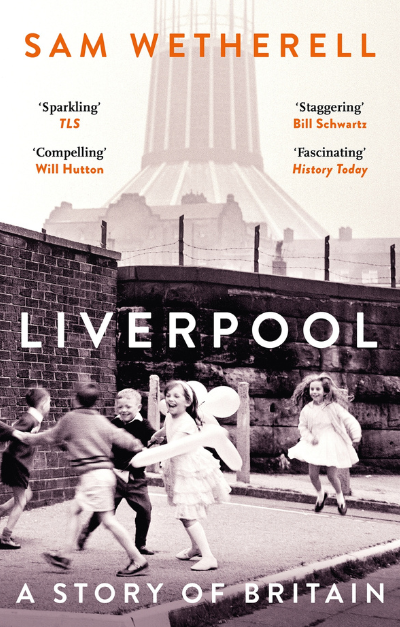
The epic history of Liverpool since the Second World War, a place in which recent British history is brought into new focus. This is an astonishing story of decline and of those fighting against it.
An extract from Liverpool: A Story of Britain
This book is about Liverpool’s past and what it might tell us about Britain’s future. In focussing on a single place, its aim is to give order to the cacophony of narratives, the diversity of experiences and the parade of individuals, that make up Britain’s recent history. It allows us to see how some of the different pieces of the postwar era—deindustrialisation, decolonisation, and the rise of a new kind of neoliberal economy—tessellated, working together to transform the lives of everyday people.
At first glance, Liverpool seems like an unusual place from which to tell a story about Britain as a whole. The city has often been seen as a place apart, its history at odds with the rest of the country. It occupies an insurgent, contrarian and almost other-worldly place within Britain’s body politic, patronised, ignored, misunderstood and in some cases brazenly hated. For this reason, the city has often been an object of curiosity. Its economy dominated by trade rather than industry, its politics shaped by Irish nationalism and Trotskyist entryism, its society home to some of the oldest and most established Black and Chinese communities in Europe, the city has long been seen as an outlier to the rest of Britain.
So why Liverpool? I argue that Liverpool’s history is a prophecy. It is where we need to look to understand our present moment; a moment that is characterised by stalling wage growth, collapsing health systems, widespread homelessness, shrinking political horizons, growing far right support among the white residents of former industrial heartlands and new demands for Black civil rights from London to St Louis. With inequality widening and climate change accelerating, the crises of surplus labour, surplus buildings and surplus people will become ever more urgent. One of the tasks of the historian is to comb through the historical darkness in search of the connecting threads between then and now. This is the history that Britain’s impending future demands we tell. Liverpool’s obsolescence might be coming for us all.
This book sets out to establish a new vocabulary for thinking about Britain’s recent history, one that is better suited for our multiple overlapping crises, as well as the crises to come. The old stories we tell about postwar Britain: the rise and fall of the “welfare state,” Thatcherism, permissiveness and decline were told by historians working in and in many instances benefiting from different political and economic conditions—different climates (in both meanings of that word). They may seem increasingly marginal as the alarm bells begin to sound for our coming century. We need histories of worklessness rather than labour, of environmental ruin rather than planning, of policing rather than welfare, of disintegration rather than hegemony. We need, in other words, to see Liverpool’s history as a prophecy.
Return to the 2026 shortlist.


