
Read the 2026 Wolfson History Prize shortlist
‘Summer of Fire and Blood’
by Lyndal Roper
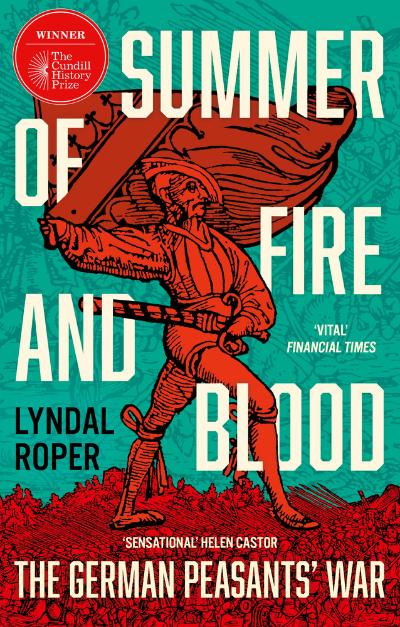
A definitive history of the German Peasants’ War, the greatest popular uprising in Western Europe before the French Revolution, by award-winning historian Lyndal Roper.
An extract from Summer of Fire and Blood: The German Peasants’ War
The German Peasants’ War was the greatest popular uprising in Western Europe before the French Revolution. Like a vast contagion it spread from southwest Germany through Württemberg, Swabia, the Allgäu, Franconia, Thuringia, and Saxony to Alsace in what is now France, Austria, and Switzerland. Peasants massed in armed bands in one region, then another, and rebellion would break out even in areas far away. At its height it involved well over a hundred thousand people, perhaps many more, who joined with the rebels to bring about a new world of Christian brotherhood. And for several months, they won. Authority and rulership collapsed, and the familiar structures of the Holy Roman Empire were overturned, exposing the fragility of the existing social and religious hierarchies. People even began to dream of a new order.
But this moment did not last. In spring 1525, the ‘Aufruhr’, or ‘turbulence’, as contemporaries called it, had reached its height, rolling all before it. By May the tide had turned. The forces of the lords put down the revolt by slaying somewhere between seventy thousand and a hundred thousand peasants. That summer of blood, maybe one per cent of the population of the area of the war was killed, an enormous loss of life in just over two months.
Despite its enormity, the Peasants’ War and its bloody defeat have been forgotten in recent years. People remember the era for Martin Luther and his Reformation, which split Western Christendom forever between Catholics and those who would eventually be known as Protestants. The Peasants’ War has come to be seen as a diversion, an interlude important mainly for what it tells us about Luther, for this was the moment when Luther came out in support of the princes and against the ‘mad dogs’, the rebelling peasants. From then on, the Reformation in Germany would be conservative. Mainstream reformers would go on to ally with rulers to advance the goals of the Reformation, and when the new church was set up after the war, it would have the backing of those in power.
The Reformation’s possibilities, as well as its limits, cannot be grasped without an understanding of the Peasants’ War as the giant trauma at its centre. Equally, the ideas, dreams, and hopes unleashed by the Reformation shaped the Peasants’ War. And the war, in turn, cannot be understood if it has been severed from the heady atmosphere of religious excitement in which it took place.
To understand why such a massive movement mushroomed from such small, apparently isolated beginnings in a distant corner of the empire, we need to listen to what drove the peasants.
Return to the 2026 shortlist.


