
Read the 2026 Wolfson History Prize shortlist
‘The Boundless Deep’
by Richard Holmes
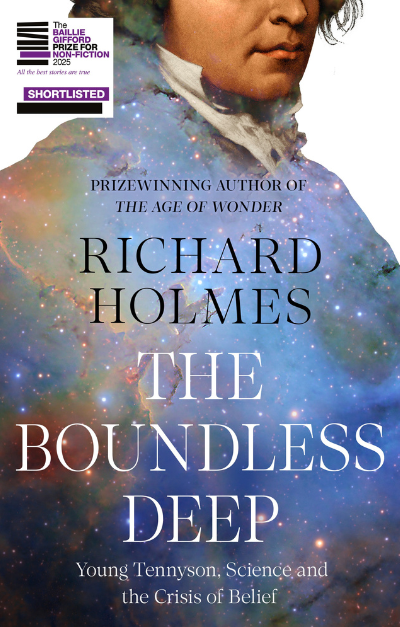
Alfred Lord Tennyson is now remembered – if at all – as the gloomily bearded Poet Laureate. In this dazzling new biography, Richard Holmes, the prize-winning biographer of Shelley and Coleridge, and author of the landmark work, The Age of Wonder, reawakens this somnolent Victorian figure and brings him back to sparkling life.
An extract from The Boundless Deep: Young Tennyson, Science and the Crisis of Belief
Alfred was a small, shy retiring boy at first, but would grow up to be over six foot tall, exotically handsome and when silent in a room, faintly menacing. His striking good looks were often described as ‘gypsy’ or Spanish, with dark deep-set eyes and magnificent tawny hair. Physically strong, he was also short-sighted, and in his twenties would flourish a pince-nez to dramatic effect. When he did speak, his voice was low and powerful, with a Lincolnshire accent, soon to be used with hypnotic effect.
To begin with Alfred shared an attic bedroom with his two elder brothers in the gabled roof at the top of the rectory, with its own creaking stairs. He remembered its enchantments long into old age. There was a large wooden beam across the ceiling, from which the brothers would swing and tell stories: ‘Knights and heroes among untraveled forests . . . or on gigantic mountains fighting with dragons’. From a skylight they could glimpse the moon and stars. Tennyson would sneak down before dawn to collect fallen apples from the rectory orchard, and especially loved wild weather. ‘Before I could read, I was in the habit on a stormy day of spreading my arms to the wind, and crying out “I hear a voice that’s speaking in the wind”.’ That sense of infinite distances haunted him. ‘The words “far, far away” always had a strange charm for me.’
From the age of ten, he revelled in long walks by the sea at Mablethorpe, a huge windswept beach some fifteen miles to the east. The family kept a cottage there, under the sea-bank, ‘the long low line of tussocked dunes’, and he would break away on his own, haunted by the ‘thunderous roar’ of the big breakers on the Lincolnshire shore. He wrote an early childhood prayer: ‘Thou art the God of Heaven and Earth. Thou has created the immeasurable sea . . . Thou givest and Thou takest life, Thou destroyest and Thou renewest.’ From his boyhood, ‘he had a passion for the sea, and especially the North Sea in wild weather’.
He would lie for hours alone upon the beach, or hidden up in the dunes, listening to the waves, imagining sea creatures far out in the deep, or dreaming of the ancient Greek invasion fleet that had set out long ago to besiege Troy, as recounted in Homer’s Iliad. He learned Alexander Pope’s translation by heart, before being enchanted by Byron’s romantic Greece. He recalled some fifteen years later (1837):
Here often when a child I lay reclined:
I took delight in this fair strand and free;
Here stood the infant Ilion of the mind,
And here the Grecian ships all seemed to be.
And here again I come, and only find
The drain-cut level of the marshy lea,
Gray sand-banks, and pale sunsets, dreary wind,
Dim shores, dense rains, and heavy-clouded sea.
Return to the 2026 shortlist.


