
Read the 2026 Wolfson History Prize shortlist
‘The Library of Ancient Wisdom’
by Selena Wisnom
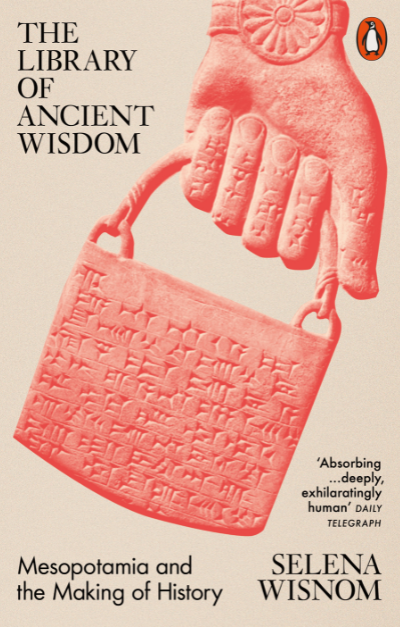
The story of the ancient world’s most spectacular library, and the king who created it.
An extract from The Library of Ancient Wisdom: Mesopotamia and the Making of History
Nineveh is located on the outskirts of Mosul in modern-day northern Iraq. The suburbs of the modern city have grown up around the centre of the ancient one. Today the ancient citadel is not much to look at – a grassy, rubble-littered hill, surrounded by houses and major roads looking out across a modern city. Yet on this site once stood one of the greatest collections of knowledge in history, containing the collected wisdom of the region we call Mesopotamia in ancient Iraq. Holding more than thirty thousand tablets, this library was assembled by King Ashurbanipal, a ruler who aspired to gather all the knowledge of his day under a single roof. Ashurbanipal scoured his empire for texts to add to his collection, obtaining copies from temples in times of peace and confiscating personal libraries in times of war. His library contained everything from the essential documents he would need to govern his lands to the most esoteric lore explaining how to read the future. It had vast stores of medical knowledge, ranging from dentistry to gynaecology, as well as prayers, songs, and great works of literature. There were accounts of victories in battle, and ancient dictionaries that have helped modern scholars to decipher cuneiform, the world’s first writing system. In the royal archive there were letters between the king and his advisers, governors of faraway provinces and rulers of other states, and records of the everyday running of the palace and the empire. The library gives us a unique and extraordinary wealth of information about this culture – not only are the highest forms of scholarship of the time found here, but the voices and everyday experiences of the individuals who used it are also preserved in the letters that they wrote to the king.
Ashurbanipal assembled his library in the seventh century BC, but he was part of a much larger story: the Assyrians were conscious of their debt to those who came before them and were just as concerned about safeguarding ancient knowledge as we are today. Therefore, as well as being a snapshot of the state of knowledge in Ashurbanipal’s time, the library is a window into the even more remote past. It helps us to understand nearly three millennia of history, preserving all kinds of texts that stretch back to the ancient states of Sumer and Babylonia and giving vital context to the centuries that follow. Ashurbanipal was the ruler of the Neo-Assyrian empire, which was not the first empire in the ancient Middle East. Two millennia earlier the region had been home to Sumerians who developed city states from the south of Iraq to northern Syria. The Babylonians and Assyrians then built their own kingdoms and vied with each other for power. ‘Mesopotamia’ is a general term that refers to this whole area, inhabited by different peoples at different times. Many developments took place in this vast time span, yet many aspects of the culture were shared and carried on. Its history is significant not just for Ashurbanipal or the Middle East, but for the whole world, as Mesopotamia witnessed numerous developments that have influenced us all in profound and often surprising ways, earning it the title of the ‘cradle of civilisation’.
As the birthplace of writing – a revolutionary technology that facilitated the keeping of records, the growth of states, and the preservation of knowledge – Mesopotamia is literally where history begins. Mesopotamian scribes wrote on clay tablets, a simple and cheap medium that has also proved to stand the test of time. Consequently, we have a huge number of sources that give us a fascinating view of the earliest literate societies in the world – the number of tablets excavated so far has been estimated at over half a million. It is often assumed that the contents of these tablets are rather dull; mostly accounts and receipts. Mesopotamia does indeed have many sources of this type, which is how we know so much about its economy and enterprise. But it also has much more: cuneiform tablets document almost every facet of human existence, from the letters of ordinary people to the calculations of advanced mathematics. Mesopotamia, then, was the seat of a rich and complex culture, much of which is represented in Ashurbanipal’s library.
~
I first discovered Mesopotamia by chance. Browsing in a bookshop one day in my late teens, I saw a new translation of the Epic of Gilgamesh and thought it looked like the kind of thing I would like. I bought it and read it in one sitting. I was struck by the familiarity of its themes and the strangeness with which they were expressed. There was something so recognisable and universal in this poem’s story of a man’s struggle to come to terms with his own mortality after the death of his best friend, and the quest for knowledge that he consequently embarked upon to the ends of the earth. This was a powerful work of literature that had connections with the classical world I knew, yet it was also mysterious and challenging, all the more for its strangeness. I ended up studying both Classics and Assyriology in sequence, journeying into the ever-remoter past.
Above all, it is the strangeness of Mesopotamia that draws me to it, and the desire to make that strangeness understandable once more. Assyriology is a quest to rediscover how the seemingly inexplicable does make sense, and to bring what was once obscure back into the light. To be an Assyriologist is to reconstruct some of the world’s most significant ancient cultures, bringing back to life civilisations that have been lost for more than two thousand years. It is a quest as exciting as that of Gilgamesh himself, and one that remains as exhilarating today as when I first began.
Return to the 2026 shortlist.


