
Read the 2026 Wolfson History Prize shortlist
‘Vanished’
by Sadiah Qureshi
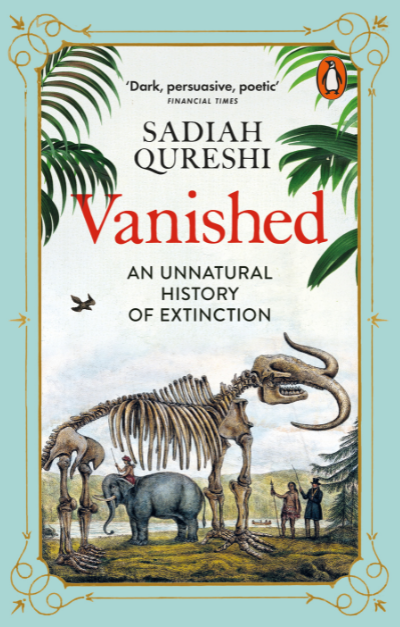
Vanished is a love letter to the astonishing ways of being that have survived past extinctions. This original and compelling history of the entangled pasts of extinction and empire suggests ways to build worthwhile futures by recognising that extinction is both a natural process and political choice.
An extract from Vanished: An Unnatural History of Extinction
Extinction extinguishes ways of being: distinct lifeways that might exist for untold millennia, even millions of years, before vanishing. Ways of being are a coalescence of possibilities, a quickening of leaf, wing, scale, and bone into lives we call ‘trees’, ‘bees’, ‘sharks’, ‘tigers’, or ‘human’. Each one is perpetuated by living, reproducing, and growing in communities over innumerable generations. Every way of being is connected to other lives through innumerable functions, whether as predator, prey, parent, or partner, that create significant relationships between lifeways. Sometimes descendants depart incrementally from ancestral ways, giving rise to new forms, until they appear distinctive enough for us to notice the difference, and perhaps even to designate them a species. We usually discuss extinction as the loss of species, but this often obscures how it robs the world of distinctive existences, many far older than any nation, humanity, and even earth’s continents.
Many of us remember the first time we realized a wondrous creature we admired was no longer living, and often that moment involved learning of the dinosaurs’ fate. Encountering extinction primarily through prehistoric loss can trick us into imagining extinction as a primarily biological process or catastrophic loss caused by natural disasters. While understandable, this underplays how we contribute to and make sense of extinction. No other species conceives of itself as in danger of extinction. No other species attempts to prevent the extinction of other ways of being, counts them as they disappear, tries to revive those already lost, or frets over its culpability.
How did we come to think of ourselves as survivors in a world where species can vanish forever, or as capable of plunging our planet into a sixth mass extinction? And how has this understanding of extinction shaped how we imagine our histories, our place in the world, and role in shaping our planet? While we craft many narratives to make sense of, and wrest meaning from, extinction, far too many histories remain untold, forgotten, or erased.
Vanished traces how naturalists reimagined extinction from acts of wanton human destruction into a scientific idea born of revolution, and the chilling choices facing us today. By weaving together histories of science, race, and empire, Vanished traces the nature of extinction as a scientific idea, imperial legacy, and political choice. Instead of a sweeping epic, this book offers kaleidoscopic glimpses of how extinction has been imagined through exemplary animals, peoples, and plants over the past three centuries. By providing a more compelling account of these past entanglements, this book seeks more worthwhile futures for life on earth. Some ways of being died out long before we existed, but the way we have imagined prehistoric and more recent losses is an unnatural history of our own making that requires fresh historical scrutiny. Extinction may be natural, but it is also a human idea that we use to make meaning from loss in a world that we might be on the verge of destroying – or saving. The choice is ours.
Return to the 2026 shortlist.


