
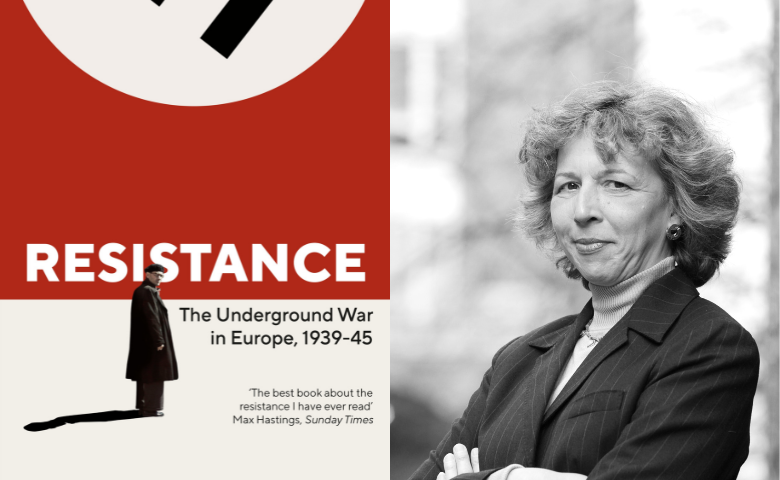
How does it feel to be shortlisted for the 2023 Wolfson History Prize?
I am thrilled and hugely honoured to be shortlisted. Not being attached to any university, I work in isolation for years, researching and writing books, without knowing whether anyone will appreciate my efforts. My inclusion on the shortlist is important to me because it shows that all this hard work has paid off, and it is a reason to hope that many more people will discover my book and learn what it has to say. It is an honour to be included among the few to receive this privilege.
What was the inspiration behind Resistance?
My last book The Eagle Unbowed: Poland and the Poles in the Second World War, showed me that resistance was widespread in Poland and that it took many forms, both armed and unarmed. The Poles suffered a terrible occupation at the hands of the Germans and in order to survive had little choice but to resist the German depredations. In other parts of Europe, especially in the west, the occupation was far more benign, so there was even a question of whether one should resist at all, or simply get on with life under new conditions. I was interested in how the extent of and the very nature of resistance changed across the continent over the war years. Common themes emerged which one-country historians had inevitably missed. I was able to go behind the ‘resistance myth’ which so many countries had constructed to heal themselves after the helplessness of wartime. Above all, I was fascinated by, and worked hard to show, what ordinary men and women could and could not achieve in the face of oppression.
Why do you feel that it is important to celebrate history writing?
For me, history can be summarised as a series of questions: who did what, when, how and why? I l feel that it is important to understand why people acted as they did, who or what influenced them, and what impact certain events have had. History is often uncomfortable because people felt and behaved differently in the past from how we think and act now, but I feel that unless we understand this uncomfortable past then we are letting ourselves in for an even more unsettling future.
Do you have a favourite historical place, or a place that has inspired you?
The place which inspires me the most is the London Library. In practical terms it is a vital resource, particularly for independent researchers, with its enormous collection and the possibilities it offers for consulting and borrowing books on a vast range of subjects. Much more important, however, is the very fact of its existence – that in an apparently commercial and goal-directed culture, where scholarship often seems to be no more than a grudgingly tolerated eccentricity, the London Library shows that scholarship still is valued, and that we still live in a civilisation which offers opportunities for serious study and research.
Was there a particular writer, book, experience or event that first made you interested in history?
My historical interests were first aroused by direct family experience: wondering why my parents had come to Britain after the Second World War. Both had been born in Poland, a country with a complex history, and my father had been deported to the Soviet Union in 1940 while my mother had fled the approaching Soviets in 1944. Both ended up in Britain in 1946, where they met. Their entire historical context seemed to have been edited out of conventional British histories of the war. I therefore became curious not only about history (particularly that of war) but also about how history is written and rewritten, sometimes unconsciously, to suit national narratives.


