
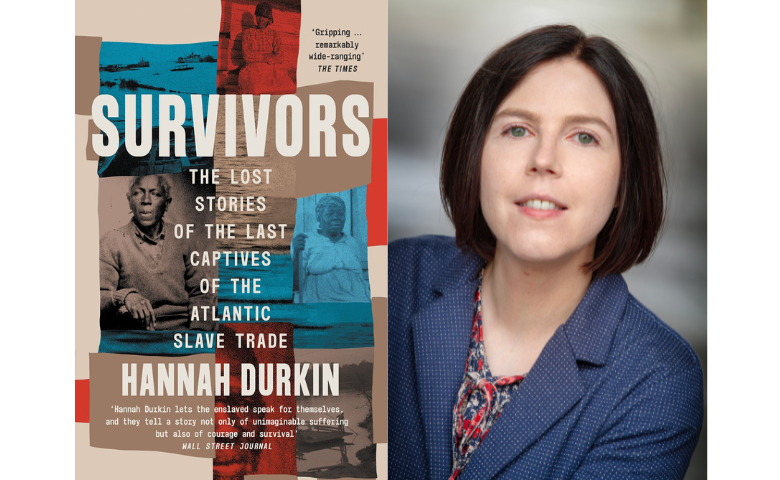
Congratulations on being shortlisted for the Wolfson History Prize 2025 for Survivors. How does it feel to be shortlisted and what would winning mean to you?
I can barely put into words what an incredible surprise and honour it is to be shortlisted for the Wolfson History Prize. While it would be so amazing to win, I already feel like a winner for making the shortlist, and I’m so grateful to the judges for considering my book to be worthy of such an accolade. It’s surreal to think my work will now be listed alongside such incredible authors and books. When I began this project, I wasn’t totally confident I could write history in a way that would appeal to general audiences. This has given me the confidence to carry on doing so.
I’m incredibly grateful to the Wolfson Foundation too. This is a challenging economic climate for non-fiction writers and having an annual award that supports and promotes history writing in such big way is so important right now. It’s also fantastic for the histories people like me seek to tell. At a time when their descendants are battling dark forces seeking to brush that past aside, hopefully my success will make more people aware of the Clotilda and its survivors and give them a fuller understanding of the transatlantic slave trade.
What does the research process look like for you? What were the key milestones along the way?
The key research milestones for this book were simple: to identify as many survivors of the Clotilda, the last U.S. slave ship, as possible, and then to find out sufficient information about them to tell their collective life stories. A large part of the process involved trawling through and comparing genealogical records. To begin to tell the Clotilda survivors’ stories, I searched online newspaper and magazine archives for interviews with them and other articles that alluded to their presence in Alabama. A lot of the historical material relating to the Clotilda and its survivors is fragmentary and needed to be read comparatively to be unpacked and interpreted. The voyage and the ship were deliberately concealed, so in most sources the ship’s name is never mentioned. But I was still stunned by how many sources I was able to uncover and how detailed a picture I was able to build of lives that were thought to be lost to history. My work owed so much to the recent digitisation of historical newspapers as well as to Clotilda descendants’ own efforts to document and keep alive their ancestors’ stories, which their own descendants very generously shared with me.
Why do you feel it is important to celebrate history writing?
In a world of increasing misinformation and disinformation, high quality history writing is absolutely essential. The best history writing not only brings the past to life but also sharpens our understanding of it. It can’t correct the wrongs of the past, but it can shed light on them and give voice to the historically marginalised and dispossessed. I was very conscious when I was researching this book that I was investigating a historical crime and bringing to light information that some people would prefer stayed hidden but which so many others, including scores of Clotilda descendants, have been waiting a lifetime to access. The transatlantic slave trade was of course a crime against humanity, but the Clotilda voyage was a crime in a legal sense too, although its participants escaped prosecution. I even learned as I was completing this book that there is a conspiracy theorist who – against all the evidence – denies the Clotilda voyage ever happened. That made my work as a historian feel more important than ever.
Was there a particular writer, book, experience or event that first made you interested in history?
I’ve been interested in history for as long as I can remember. My aunt, who sadly passed away last year, was passionate about the subject. I remember her getting my sister Frances and I really invested in Richard III and the disappearance of the Princes in the Tower when I was about seven. That must have had some effect on the pair of us as my sister is a historian too! Even before then, I remember collecting a series of history magazines for children, each centring on a different historical figure. I’d have been four or five when we started collecting them and we got the whole set. I used to try – and always failed – to read them from beginning to end, but that’s where I first learned about historical figures like Joan of Arc and Dr. Martin Luther King. The great man (and occasional woman) version of history it promoted to a coalminer’s daughter growing up in the Midlands frustrates me now though. I remember reading the Elizabeth I issue and concluding from it that if you weren’t part of the royal court then you were somehow lost to history or not important. I’ve since revised that perspective!
The Wolfson Foundation awards grants to a wide variety of museums, historic buildings and landscapes. Do you have a favourite historical place, or a place that inspired you?
I was in Montgomery, Alabama in March. While there, I went with three great-granddaughters of last Clotilda survivor Matilda McCrear to visit the city’s new Freedom Monument Sculpture Park. Memorialising slavery in a way that’s both frank and sensitive to those who endured it is incredibly challenging, but this place did so brilliantly. It’s such a peaceful space and the artwork – by leading Black and Native American artists – is monumental. We were all totally inspired and moved by the end of it. We had to briefly cross the Alabama River by steamboat to get to the park, which to me felt particularly profound. Not only were enslaved people shipped for sale on that river, but the Clotilda survivors were kidnapped by the men who owned the boats and some of them were forced to work on it. Sadly, at least one Clotilda captive drowned while doing so. Another highlight was the giant memorial wall that records the surnames of all the freed people listed on the 1870 census. Being the nerd that I am, I remembered the unusual way Matilda McCrear’s surname was spelled on that census, so we managed to locate her on the wall.
Read an extract from Survivors: The Lost Stories of the Last Captives of the Atlantic Slave Trade.
Top images: ‘Survivors’ book cover; portrait of Hannah Durkin (c) Matt Jamie


