
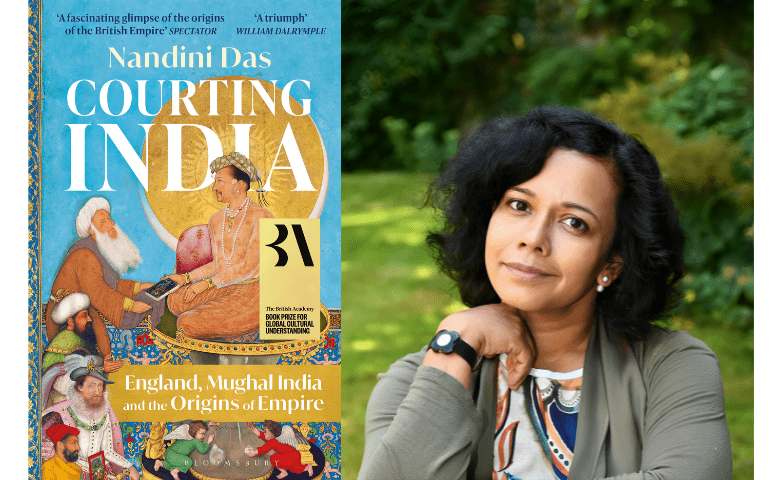
Congratulations on being shortlisted for the Wolfson History Prize 2024. How does it feel to be shortlisted and what would winning mean to you?
I am deeply honoured to be on the shortlist for the Wolfson History Prize. Courting India was a labour of love, and an attempt to recover something of the early history of the deeply fraught, deeply complicated relationship between the two countries I am fortunate to call home, so this recognition means even more to me.
What was the inspiration behind Courting India?
When we think about the British in India, our attention is drawn immediately, and for understandable reasons, to the late 18th and 19th centuries, the heyday of the British Empire. As someone working on 16th and 17th-century England, I wanted to understand what preceded that imperial ambition and colonial exploitation, and I also wanted to push against that somewhat proleptic assumption we make, that the British Empire was always meant to be. The history of the first English embassy to the court of the Mughal emperor, Jahangir, reveals the unpredictability that characterised England’s global aspirations in this period: for Sir Thomas Roe, the beleaguered English ambassador, English presence in India was hardly a given. Yet the prickly sense of European, English, Protestant superiority that Roe drew around himself like armour in response would shape English assumptions about India, and the fate of the subcontinent, for centuries to come. And that points to something else that drew me too. The cross-cultural exchanges that Courting India explores did not take place in a vacuum. They were shaped by encounters that came before, by preconceptions and assumptions, and by individual and collective memory. I wanted to explore those connections between the familiar and the foreign, ‘home’ and ‘abroad’, to see the actions of Roe and his contemporaries against the deeply entangled backdrop of early modern global geopolitics.
What does the research process look like for you? What were the key milestones along the way?
Courting India has been a long time in the making: more than ten years of research, countless visits to archives, and more hours spent deciphering the handwriting of Roe’s meticulously detailed journal than I would care to remember. It is probably best not think about milestones because I fear that would probably put me off finishing the next book: it would remind me exactly how long that process had taken.
There are moments along the way, however, that I would gladly remember. Finding fleeting references to Bengali sailors in early 17th-century London was one, attempting to recreate a Mughal recipe that may have been similar to something Roe was served at a banquet was another. And throughout, there were moments when the juxtaposition of English and non-English records suddenly fit together like the pieces of a jigsaw, or one of those overlapping scenes seen through an old-fashioned fairground stereoscope, offering an instance of unexpected, exhilarating clarity.
Why do you feel it is important to celebrate history writing?
History writing, and the academic work we do in the arts and humanities in general, is under increasing scrutiny. Celebrating what is achieved through such work – the new perspectives that come into view, the new voices and spaces that are made available, the new understanding that it generates – is now, I feel, more important than ever.
The Wolfson Foundation awards grants to a wide variety of museums, historic buildings and landscapes. Do you have a favourite historical place, or a place that has inspired you?
A spur-of-the-moment diversion to my travel plans while writing Courting India a few years ago took me to the quiet village of Odcombe in Somerset. It was late afternoon on a very hot day, and the village street was deserted. At the top of a steep turn, in the Church of St Peter and St Paul, there was the thing I had hoped to see – a stone replica of a pair of early 17th-century shoes marking the exploits of Sir Thomas Roe’s contemporary, the traveller Thomas Coryate. The shoes are a memorial to the journey on foot across Europe which had established Coryate’s idiosyncratic reputation as the ‘Odcombian Legstretcher’, but Coryate was to undertake an even longer journey across the Middle East, which would finally take him to Jahangir’s court in Ajmer in 1615. There, he would proceed to embarrass the new English ambassador by introducing himself to the emperor as a poor traveller in search of alms from a faraway small country called ‘Mulk Inglistan’. Coryate died soon after from illness and was buried in India, but that day, standing in the cool porch of his parish church with the bees buzzing outside, I thought he would have been appreciative of the odd twist of fate that had brought me to that door, and pleased that someone, somewhere, thought that his part in history counted too.
Read an extract from Courting India: England, Mughal India and the Origins of Empire.


