
Read the 2024 Wolfson History Prize shortlist
‘Out of the Darkness’
by Frank Trentmann
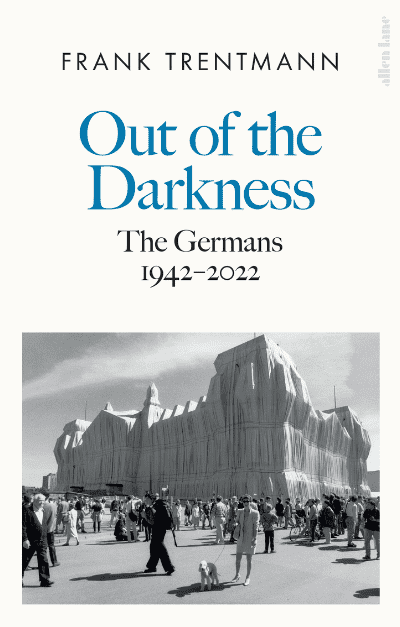
Out of the Darkness follows the German people from the Second World War to the present to understand their moral transformation and its limits. The book provides a new kind of history centred on complicity, compassion and conscience and struggles about right and wrong.
An extract from Out of the Darkness: The Germans, 1942-2022
We know today that the Allies bombed German cities to break the home front, not to avenge the murder of the Jews. For many Germans at the time, however, these two issues were linked. Intelligence reports in 1943–4 cited a growing number of these voices. In Schweinfurt, a centre of the armaments industry in northern Bavaria, locals said they were being bombed in August 1943 in revenge for the Kristallnacht pogrom of 1938. In Bad Brückenau, a spa town in the rolling hills of the Rhön mountains to the north, some said that the ‘whole attitude to the Jewish question’ and its solution had been ‘fundamentally wrong’. Now ‘the German population had to pay the price for it’.[1] A Berliner put it succinctly in November 1943: ‘Do you actually know why our cities are being bombed? Because we have bumped off the Jews.’[2]
What did he mean by ‘we’? The question of complicity in these statements is a tricky one. Some of the people quoted above might have taken refuge in the thought: we are being bombed because others (Nazis) maltreated the Jews in ways we never approved of. In medieval Rothenburg ob der Tauber, the local Nazi Party training centre complained in October 1943 of a revival of the ‘fairy tale of the “decent Jew”’: many people believed that ‘the Party had been too hard on the Jews, and now they had to pay the price’.[3] Still, there was also a sense that the war was a collective project. The deportations were the final step on the road to mass murder, but the steps leading up to them had been discrimination, exclusion, robbery and assault. All of these had taken place in public and often involved public participation. Many Germans now lived in the homes of Jews, slept in Jewish beds, ate off Jewish porcelain. With the war turning against them, there was growing unease about how Jews might respond to the seizure of their property.
Germans have a saying: ‘Mitgefangen, mitgehangen’ (caught together, hanged together). That, of course, is an extreme view of complicity since it punishes everyone equally regardless of the degree of their participation. The Nazis practised a perverse cult of collective retribution. Hostages and civilians could be executed because they were guilty by extension for sabotage or the killing of individual German soldiers in their community, a policy enforced in colonial wars that had now been radicalized. Collective punishment reflected the lack of regard for individual life. The Nazis revived the medieval concept of Sippenhaft (kin liability) in which a whole family shared the responsibility for an act by one of its members – from late 1942, this would be applied to the wives, children and brothers of deserters and, then, to the families of those who tried to assassinate Hitler in the bomb plot of 20 July 1944. After 1945, the sense of guilt would undergo major changes. Here it is worth stressing that between 1943 and 1945 complicity for crimes committed in their name was not an alien concept for many Germans.
Knowledge of German atrocities undermined condemnation of Soviet crimes. In the spring of 1943, Nazi propaganda tried to exploit the discovery of mass graves in the Katyn forest in Smolensk, Russia, where the Soviets had executed Polish officers and intelligentsia, by presenting them as the ‘work of Jewish butchers’. The public reaction ranged from aggressive antisemitism to critical self-examination. In Berlin the security service reported the gist of opinions which, it said, circulated especially among educated and religious groups: ‘We do not have the right to get upset about Soviet measures, because Germans have eliminated far more Poles and Jews.’ Similar views were uttered in rural Lower Franconia. In Halle (in the Prussian province of Saxony), opinion was split between those who wanted to ‘Kill the Jews’ and those who said that if the Germans had not attacked the Jews in the first place, they would already be enjoying peace. The ‘shock of Stalingrad has still not faded away’, the district president of Swabia observed in June 1943, and there were fears Russians might kill German POWs ‘in revenge for alleged German mass executions of Jews in the East’.[4] By November 1944 the security branch in Stuttgart criticized Nazi propaganda about the Red Army massacre of German civilians in Nemmersdorf (today Mayakovskoye, Lithuania), the first village in East Prussia to fall to the Soviets, because it so easily backfired. ‘Numerous voices’ in the population were saying:
Every thinking person who sees this blood sacrifice will immediately think of the atrocities that we have committed in enemy lands, indeed, even in Germany itself. Have we not slaughtered the Jews in their thousands? Do soldiers not report again and again that Jews in Poland had to dig their own graves? And what we have done to the Jews in Alsace in the concentration camp? Jews are human, too. Thus, we have shown the enemies how they can treat us if they win.[5]
That was a lot of ‘we’s. A sense of complicity for crimes committed in their name was spreading among those on the home front.
[1] April 1944, SD Bad Brückenau, quoted in Die Juden in den geheimen NS-Stimmungsberichten 1933-45, eds. O. D. Kulka and E. Jäckel (Düsseldorf, 2004), p. 540.
[2] Frank Bajohr und Dieter Pohl, Der Holocaust als offenes Geheimnis (Frankfurt am Main, 2006), quoted at p. 67. See also the intelligence reports in Appendix F, in S. Schrafstetter and A. Steinweis (eds.), The Germans and the Holocaust (New York, 2016).
[3] 22 Oct. 1943, in Die Juden in den geheimen NS-Stimmungsberichten, p. 532.
[4] 19 May 1943 (Berlin); 22 May 1943 (Halle); 10 June 1943 (Augsburg), in Die Juden in den geheimen NS-Stimmungsberichten, pp. 516–22; Verfolgung und Ermordung der europäischen Juden durch das nationalsozialistische Deutschland 1933–45, XI: Deutsches Reich und Protektorat Böhmen und Mähren, April 1943–45, eds. Susanne Heim et al. (Berlin, 2020), doc. 23, SD informer, Warthegau, May 1943, p. 158.
[5] 6 Nov. 1944, in Die Juden in den geheimen NS-Stimmungsberichten, p. 546.


