
Congratulations on being shortlisted for the Wolfson History Prize 2024 for Out of the Darkness. How does it feel to be shortlisted and what would winning mean to you?
I feel humbled and honoured. Several Wolfson History Prize winners have been teachers and colleagues, and their books have been sources of inspiration ever since my student days – Simon Schama; Eric Hobsbawm; John Brewer; Mark Mazower. Their work keeps reminding me why history matters and what we, as researchers, teachers and writers, should be doing: ask new questions, look at sources in fresh ways, and bring the past to life. History is argument and fun. A lot of energy and emotion went into the writing of Out of the Darkness to take readers along the remarkable and often surprising moral journey of a complicated nation. To be shortlisted is a great honour, to win I would take as reward for experimenting with new ways of writing history.
What does the research process look like for you? What were the key milestones along the way?
The historical problem I set out to explore with this book concerns the moral reorientation of the German people after Hitler. From day one, this forced me to be creative in my research, since archives are not organised by moral categories. I therefore identified topics where moral concerns played a major role in society, politics and the economy – the guilt question; pacifism; reparations; social aid; thrift and debt; the duty of parents and children, and so forth. I then researched a wide variety of archives and libraries. Two milestones I would single out. The first are letters, diaries and other so-called ego-documents – the letters by a German Jewish woman to her cousin in America in 1947, for example, made me rethink views of guilt. Second, there are the rich and underused archives of church bodies – I was often the only reader. These contain revealing and moving sources that enabled me to reconstruct the experiences of migrant workers, disabled people, single mothers, poor pensioners, volunteers and many others who deserve to be heard more than they have been in standard histories of contemporary Germany. It shows that it pays off to dig deep in the archives.
Why do you feel it is important to celebrate history writing?
In recent years, history has come under a lot of pressure, in the United Kingdom and elsewhere. Student numbers are down and history departments have been squeezed. This is equally strange and worrying. History teaches you how to research, write and think – all things we need. History is also an essential part of civic life, because it simultaneously teaches empathy with past societies and makes us look differently at the present. Good history writing reminds us that a different world is possible. Arguably, the past and our understanding of it are today more relevant than ever. Look at the many crises now – they all involve history: debates about genocide; the war in Ukraine and Russian ideas of past glory; populism and references to Weimar; the legacies of empire and slavery; the evolution of a fossil-fuel lifestyle. Good history writing is as vital as fresh air – and without it, our public as well as our private lives will be stunted.
Was there a particular writer, book or experience that first made you interested in history?
Not a book but probably a person. At school, in Hamburg, I had specialised in biology as well as history, and when I was offered a place to study medicine it was hard to refuse. In hospital, I then came to know one of the patients and helped look after her once she was back home. She had been born in 1898 into a family of assimilated German Jews. I was fascinated by her memories, especially her accounts of growing up in Potsdam under the Kaiser and, then, her experiences in Weimar and Nazi Germany. Looking back now, I am sure those afternoons played a role in me switching from medicine to history.
The Wolfson Foundation awards grants to a wide variety of museums, historic buildings and landscapes. Do you have a favourite historical place that inspired you?
I grew up in Hamburg and the ruins of St Nicolai church, which was bombed during Operation Gomorrah in 1943 and stands as a memorial to the Second World War, are firmly imprinted on my mind.
Read an extract from Out of the Darkness: The Germans, 1942-2022.
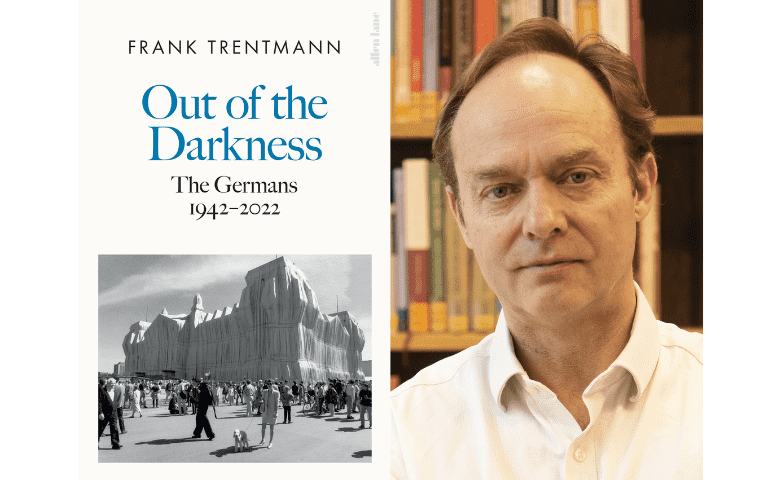
Top images: ‘Out of the Darkness’ book cover; Portrait of Frank Trentmann, credit Jon Wilson


